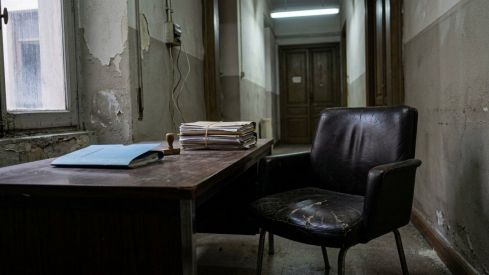
Justice in the regions of Girona faces a staff shortage that coincides with the entry into force of the new organizational model provided for by the efficiency law. The change has eliminated reinforcements that judicial bodies had been using on a stable basis and has aggravated the overload in a district that has vacancies and courts with space problems.
The paradox is summarized by the Catalan judicial leadership itself. Mercè Caso, president of the High Court of Justice of Catalonia, maintains that the court system of instance courts is a "good model" on paper, but adds that it has clashed with an "insufficient" staff and a reorganization that has withdrawn support previously considered almost structural.
Twenty of the 84 judge positions are still held by substitutes
Adolfo García Morales, president of the Girona Court of Appeal, stated that 20 of the 84 judge positions in the district are occupied by substitutes and not by permanent judges. In his diagnosis, it is "horrifying" to keep so many "empty chairs" in bodies that are already working with a high workload.
The pressure is felt with particular intensity in the civil jurisdiction. Since the pandemic, the civil sections of the Court of Appeal have gone from 200 to more than 600 cases per magistrate, a figure that triples the previous volume and concentrates a large part of the backlog.
In addition to requesting more positions, the governing council of the TSJC maintains its claim for an economic supplement for judges and magistrates assigned to Catalonia. The argument is that the higher cost of living makes it difficult to consolidate staff and favors the mobility of those in their first assignment.
The lack of stability does not only affect Girona capital. The court has also set among its priorities a new position in Figueres, another in Santa Coloma de Farners, another in Olot, and two more in the civil section of the Girona court of instance, within a package of nine new positions for the entire district.
The TSJC requests nine positions, but the new promotion will not arrive until 2027
Mercè Caso explained that the ministry's intention is to publish these nine positions throughout the year. Nevertheless, she warned that the problem is no longer limited to authorizing new assignments, but to finding who can occupy them in a system with a deficit of personnel.
The TSJC has requested from the State an extraordinary call for competitive examinations to expand the staff of judges, also through the fourth channel. The urgency has a background date, because the next promotion graduating from the judicial school will not be available until early 2027.
During the transition to the new scheme of courts of instance and judicial offices, Caso has also pointed out that reinforcements that were previously practically structural have been cut. The Departament de Justícia has committed to returning them, although that return has not yet materialized.
Santa Coloma de Farners will remain divided between two locations until 2030
One of the clearest examples of material deficiencies is in Santa Coloma de Farners. The governing council of the TSJC denounced that the courts are working in "two unacceptable buildings" and stressed that both locations are not even close to each other.
The efficiency law maintains the judicial districts, but replaces the traditional model with courts of instance with collegiate organization and judicial offices that concentrate common services. In Girona, that reform arrives while personnel deficits and infrastructure problems persist in different points of the demarcation.
In the case of Santa Coloma de Farners, the official calendar of the Departament de Justícia places the start of the works for the new judicial building in the first half of 2028 and its entry into service in 2030.