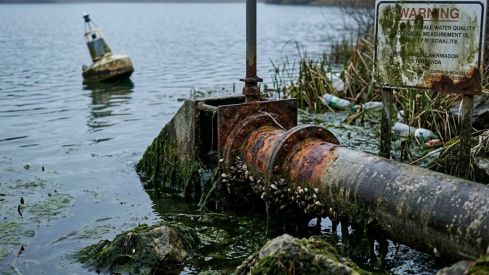
The Darnius i Boadella reservoir, built in 1968 to contain the waters of the Muga and prevent floods, today supplies numerous municipalities in l'Alt Empordà while the basin suffers from deterioration affecting both the river and the aquifers. A diagnosis by the Institució Altempordanesa per a l'Estudi i Defensa de la Natura warns of the poor state of the waters, the loss of biodiversity, the overexploitation of the resource, and the entry of exotic species through the dam.
The main tension arises in the very use of the infrastructure. The dam guarantees supply to the population, but the report maintains that the demand for supply and irrigation has lowered ecological flows below what was planned by the Catalan Water Agency in 2006, with effects on water quality and the conservation of the river system.
Four water bodies of the Muga remain in poor ecological condition
According to ACA data collected in the diagnosis, of the 10 water bodies into which the Muga and its tributaries are divided, six are in good ecological condition and four are in poor condition. In groundwater, the situation is more delicate, as only one of the four evaluated bodies is in good condition.
Furthermore, most of the analyzed points in the aquifers show pesticide levels above the recommended threshold. The document also records a decrease in fish populations and an increase in nitrate pollution in recent years, with 34 populations declared vulnerable zones, although not all of them are part of the basin.
Iaeden links this deterioration to the water stress suffered by the basin and the non-compliance with maintenance flows. The entity calls for the application of at least the values set by the ACA in 2006 to avoid both nitrate pollution and the salinization of aquifers.
"The application, at a minimum, of the flows proposed in the ACA's 2006 Maintenance Flows Plan is necessary and urgent." - Iaeden-Salvem l'Empordà, environmental organization
The flow in Pont de Molins dropped to 7.15 hm³ in normal conditions
In Pont de Molins, the diagnosis details this reduction. The proposed flow should be 69 hm³, but it has been reduced by 40% and stands at 7.15 hm³ in normal conditions and 4.34 hm³ in alert conditions due to the growing demand for water for the population and irrigation.
The report adds that the reservoir also functions as an entry point for invasive species. Iaeden maintains that the Muga basin is among those that have seen the greatest increase in exotic species since 2013 and among those with the highest probability of plant invasion.
At that point, the entity denounces that the system for disinfecting boats has still not been installed despite the material having been acquired years ago, a measure intended to prevent the introduction of the zebra mussel. The diagnosis summarizes this with a direct criticism of the delay in the implementation of that control point.
"It is intolerable that years ago the material for disinfecting the boats in the reservoir was acquired to prevent the introduction of the zebra mussel, but the disinfection point has not been installed." - Iaeden-Salvem l'Empordà, environmental organization
Looking ahead, the document proposes reviewing urban development on the coast and adapting urban planning to the real availability of water. It also proposes improving the efficiency of supply and irrigation networks, curbing the expansion of pig farms, replacing water-intensive crops such as corn, creating a Muga Basin Council, promoting reuse, and moving towards public management of the resource.
Among the most concrete data from the diagnosis, groundwater concentrates one of the worst balances, because only one of the four groundwater masses is in good condition and most of the evaluated points exceed the recommended threshold for pesticides.