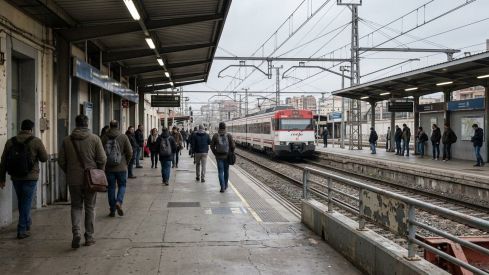
The complete recovery of the Rodalies service will not arrive until June, a month later than what the Govern had maintained this week, in a crisis that remains open more than four months after the Gelida accident and that keeps several sections without service in the Catalan network.
Adif places the new forecast after a succession of unfulfilled deadlines. First, the Secretary of State for Transport, José Antonio Santano, assured that most of the temporary speed limitations would be lifted in February. Later, he postponed that horizon until the end of April. On Tuesday, the Minister of Territory, Sílvia Paneque, stated that these restrictions would be extended "at most" until the first week of May. Now, the total return to normality is delayed until June.
More restrictions and a punctuality under minimums
The Catalan railway network has this week 216 active temporary speed restrictions, compared to the 133 there were on January 1. To try to reduce them, Adif has managed to simultaneously deploy 400 workers at different points of the network.
The impact on the service remains very high. According to Renfe's latest figures, only 16% of Rodalies trains arrived on time at their destination. The rest accumulated an average delay of 26 minutes. Added to this is the cancellation of more than 5,300 services in January and February 2026, a period in which Rodalies de Barcelona lost more than two million passengers.
110 million in emergency works in two months
Adif has invested 110 million euros in emergency works in just two months to face the incidents and accelerate the recovery of the network. That amount is equivalent to what was allocated by the railway manager to the maintenance of Rodalies during the last six years.
In parallel, the Department of Territory has allocated more than 11.2 million euros to reinforce its interurban bus lines since the beginning of the crisis. The first reinforcement on the trains of Ferrocarrils de la Generalitat de Catalunya had a cost of 128,693.30 euros. It is also expected that lifting the toll on the C 32 during the closure of the AP 7 will exceed six million euros.
Sections that remain closed
More than four months after the Gelida accident, several sections of the network remain without service due to effects derived from the accident.
- Riba roja and Reus on the R15
- Sant Sadurní d"Anoia and Martorell on the R4
- Martorell and Rubí on the R8
- Ripoll and Puigcerdà on the R3
Exchange of reproaches between administrations
The president of Adif, Luis Pedro Marco, defended in Congress the actions of the railway manager and stated that the crisis management is "to take one's hat off". In the Transport Commission he also maintained that "the service disruptions are such, and the alternative transport plans are such, that nothing more can be done."
Marco also assured that Adif is not executing more works on the Rodalies network because the Generalitat requests it. In that context, the Govern conveyed to the Ministry of Transport its request to delay the scheduled maintenance works in the Garraf tunnels. Minister Óscar Puente rejected that postponement and concluded that "it could not wait any longer." The position of the Catalan Executive was to wait for the reopening of more closed sections after the Gelida accident before assuming new disruptions.
Sources from the railway sector also maintain that the labor conflict would also be influencing the recovery of some corridors and point to the actions of unions like Semaf, to whom they attribute an alleged blocking of the reopening of some of these sections in their struggle with the company. Meanwhile, users continue to face delays, cancellations and a horizon of normalization that is once again moving away in the midst of the Rodalies network.