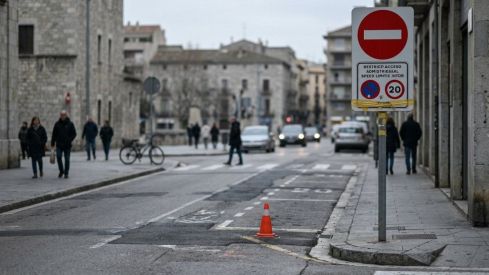
The Girona City Council will study restricting circulation in Plaça de Catalunya to residents and freight vehicles after reaching a consensus in the participatory process opened in March with 42 entities and associations. Access will be controlled with a camera on the east road, at the intersection with Carrer del Carme.
The proposal excludes the complete pedestrianization of the square, an option that is currently ruled out after complaints from residents and merchants about the pilot test carried out between September 16 and November 11, 2024, on the west road. Instead, the council plans an entry filter with which it expects to reduce daily traffic from 4,000 to 1,000 vehicles.
The camera will limit passage to residents of specific streets
The system will only allow entry to vehicles of people registered in Plaça de Pompeu Fabra, Plaça de Catalunya, Avinguda de Sant Francesc, and Carrer del Carme from the Pont de l'Areny. It will also include residents from the influence areas of Pedreres-Fora Muralla and Torre Gironella.
Isaac Sánchez, councilor for Mobility and Public Space, identified this restriction as the main tool to reduce traffic intensity in one of the city's central points. The city council will still need to specify the technical feasibility of the system, the influence areas, and the authorization criteria before activating it.
Then will come the information campaign and the opening of the application period for authorized vehicles. Implementation will be progressive.
"It is part of the municipal strategy of urban pacification and renaturalization to move towards a more sustainable and livable city for people" - Isaac Sánchez, councilor for Mobility and Public Space, Girona City Council
The south road will become a two-way exit
The traffic reorganization will include a two-way street on the south road to facilitate vehicle exit towards Passeig General Mendoza. For cars coming from Carrer del Carme, the most direct route will be to turn onto Pont de l'Areny.
The plan also foresees changes in the distribution of space. The city council will set up a parking area for bicycles and cargo bikes next to the Girocleta station, an action that will involve the loss of parking spaces for motorcycles and will be compensated with new reservations around the square.
In addition, the council will free up the environment of Pompeu Fabra square where there are now spaces for people with reduced mobility and motorcycles. The spaces for reduced mobility will be relocated to a nearby area.
Another of the measures under consideration affects the taxi rank on Sant Francesc avenue, which the city council wants to move to the west lane of the square. The current space would be used for loading and unloading.
The works on the square will not start until the end of the year
The traffic rearrangement will still coexist with the structural reinforcement works on Plaça de Catalunya, which are ongoing and have required precautionary measures. These limitations will be partially lifted when those works are completed.
As detailed by Isaac Sánchez, the city council will not combine these works with the upcoming actions planned to repair the surface in l'Hospital and Pompeu Fabra squares. The works on Plaça de Catalunya will not begin until the end of the year.
In a statement, the mayor of Girona, Lluc Salellas, stated that the participatory process represents an "important step" to transform Plaça de Catalunya into a "space designed for people," maintaining accessibility and necessary daily uses.