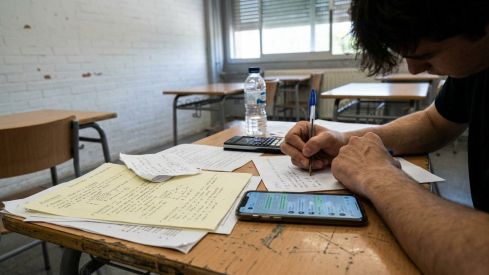
University entrance exams will be held on June 9, 10, and 11, and many students are facing the final stretch with artificial intelligence tools to prepare for the exams. They use them to request simulations, strict corrections, study plans, and advice on how to manage their time and rest.
The paradox appears in this very use. The technology serves to practice subjects that concentrate a good part of the pressure, such as Mathematics, History, Philosophy, Languages, Physics, Chemistry, and Biology, but it can also increase anxiety when it exposes knowledge gaps just a few days before the Selectivitat.
Ruben Pino defends AI as support, but not as a substitute for class
Ruben Pino, representative of the Territorial Board of Secondary Education in the Girona region and director of the Montilivi Institute in Girona, believes that artificial intelligence can be useful if students use it with judgment and critical thinking. In his view, the tool is suitable as a complement to practice the syllabus, not as a replacement for prior work in the classroom.
"Artificial intelligence has come to stay and it is already a learning in itself that they learn to use it, but it must be a support for studying that allows them to practice the syllabus, in no case does it replace having gone to class, and they must use it with a knowledge base because one of the big problems with artificial intelligence is hallucinations" - Ruben Pino, representative of the Territorial Board of Secondary Education in the Girona region and director of the Montilivi Institute in Girona
In this prior preparation, students turn to these platforms to generate practice exams, request more demanding corrections, or structure review schedules. Pino especially recommends models that allow uploading personal documents, such as NotebookLM, because they work on the sources provided by the user and limit the appearance of invented answers.
Àngel Guirado warns that AI questions can increase anxiety
From the psychological field, Àngel Guirado, an expert in educational psychology and president of the Girona Delegation of the Official College of Psychology of Catalonia, maintains that this technological help does not by itself reduce the tension prior to the Selectivitat. His warning focuses on the effect produced by facing new questions when the exam is already close.
"Artificial intelligence cannot help reduce the anguish and anxiety before an exam like the Selectivitat, on the contrary, it will very likely make it grow because it asks questions that make you realize that there are still many things you don't know" - Àngel Guirado, expert in educational psychology and president of the Girona Delegation of the Official College of Psychology of Catalonia
For Guirado, the preparation in these days requires organizing study in advance and not concentrating all the effort on the eve. He also advises maintaining adequate sleep and eating routines, exercising, and leaving the day before the tests for leisure and socialization activities instead of falling into compulsive study.
The PAU will start on June 9 and will take place over three days, until June 11.