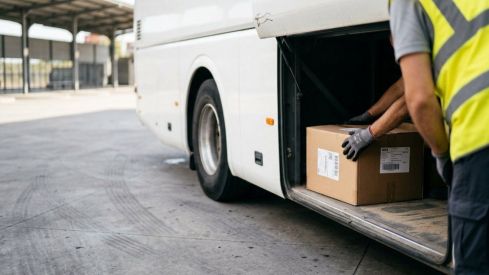
Sagalés is testing a system in the Mataró, Granollers, and Sabadell corridor to distribute goods using the empty luggage compartments of interurban buses on the e13 line. The pilot proposes that vehicles make their usual route and use that space to transport packages to stations where they are concentrated in small storage points.
The paradox driving the project lies in the cost of delivery outside large urban centers. Delivering a package in small municipalities can cost between 30% and 60% more, while buses with free capacity travel the same route every day. The initiative was presented this Thursday at the Catalan Mobility Conference of the Association of Municipalities for Urban Mobility and Transport, held in Vilanova i la Geltrú.
The e13 line uses the empty luggage compartment to bring packages to stations
Zoï Geeraert, operational coordinator of Som Ecologística, explained that the system does not add vehicles to the transport circuit. The drivers themselves load the cargo onto the bus and then leave it in storage spaces called nanohubs, located at the stations.
"We are not incorporating any new transport, and the bus makes its usual route every day with the empty luggage compartment" - Zoï Geeraert, operational coordinator of Som Ecologística
From these points, a local company handles the last-mile distribution by bicycle. The project also involves the Swiss firm OVO Logistics, which proposes implementing these spaces in towns to concentrate goods and distribute them with local operators.
In parallel, new logistics formulas are also being tested in Sant Cugat del Vallès and Mollet del Vallès, with models adapted to different urban distribution problems.
Sant Cugat and Mollet test different models to extend local delivery
In Sant Cugat del Vallès, the pilot aims to increase efficiency in cycle logistics in areas where there is a large distance between the distribution center and the delivery points. In Mollet del Vallès, the trial places the nanohub outside the urban center and situates the cargo bikes there to facilitate future expansion of the model to other towns.
Gerard Llobet, councilor for Mobility of the Vilanova i la Geltrú City Council, maintained that the current management of distribution in municipalities does not conform to current reality. Among the measures he advocated are sustainable urban logistics plans, municipal mobility companies, and microhubs with the participation of local third-sector companies.
The ATM is preparing a tool with operator data for municipalities to plan
Manuel Valdés, general director of the Metropolitan Transport Authority, called for a change of focus in urban goods distribution and asked for it to be addressed from a metropolitan dimension. The ATM will soon present a tool to help city councils plan with data from all operators and their activity.
Carme Javierre, director of Corporate Operations of Grup Giró, asked city councils to sit down with logistics operators to review the system. Javierre maintained that these companies have the information and concrete proposals to improve it.
The Mollet del Vallès trial places the nanohub outside the urban center and puts cargo bikes there with the intention of later extending the model to other towns.