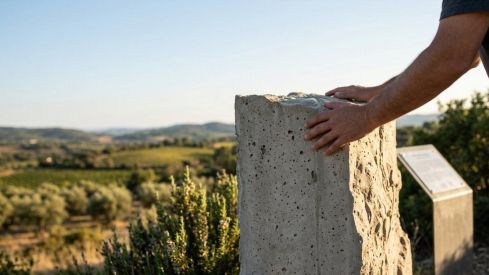
Garriguella has incorporated a new viewpoint dedicated to the 380 bunkers of the Pyrenean Line that the municipality preserves into the Xarxa Espais de Memòria. The musealized balcony, located on the C-252 road, has been inaugurated as a space to explain the post-war period and the Franco dictatorship based on one of the largest concentrations of fortifications in the country.
The paradox of the project lies in the place itself. A military infrastructure built between 1944 and 1957 to respond to a possible external invasion now becomes a point of dissemination on democratic memory and an entry point to a heritage that for years remained in the background.
Garriguella incorporates a viewpoint on 380 bunkers into the memorial network
The new facility is located in an enclave from which the defensive system of the P Line, a network built in the Pyrenees between 1944 and 1957, can be interpreted. In Garriguella, this legacy is concentrated in 380 bunkers, a figure that places the municipality in the Alt Empordà among the most unique points of this military heritage.
Raquel Salas, mayor of Garriguella, emphasized during the inauguration that the municipality is "in a way, a small Normandy," considering it the town with the highest density of bunkers in the country. The mayor added that the project opens an opportunity to publicize the town and showcase its potential.
"Garriguella is, in a way, a small Normandy, being the municipality with the highest density of bunkers in the country" - Raquel Salas, mayor of Garriguella
The viewpoint is integrated into the Xarxa Espais de Memòria with a proposal that is not limited to observing the landscape. The intervention seeks to preserve the memory of the post-war period and Francoism through an interpretive tour of the fortifications and their historical significance.
Espadaler links school visits with the defense of a democracy that is not guaranteed
During the event, Ramon Espadaler, Minister of Justice and Democratic Quality, celebrated that the space is already being used to bring groups of students and young people. In his opinion, this pedagogical dimension allows us to convey that democracy was not a gift nor is it permanent.
"I think it's magnificent to hear that groups of students and young people are brought here because it's a very good way to convey to them that democracy was not given to us nor is it perennial, but that we must fight to preserve it" - Ramon Espadaler, Minister of Justice and Democratic Quality
Espadaler also defended that initiatives of this type put memory at the service of "its true objective", which he summarized in the expression "never again". In the same vein, Miquel Noguer, president of the Diputació de Girona, maintained that the recovery of the space helps to dignify an often unknown heritage and to give it a cultural and territorial function.
The intervention also incorporates a central piece for reading the surroundings. The architect Adela Geli Anticó signs a concrete work that recreates the local topography and allows a visual interpretation of how the defensive system was distributed from this point in Garriguella.
Each fortification is identified with its own iconography according to its military function. The ensemble has been resolved with photoluminescent resin, so that the layout of the bunkers can also be read at night from the musealized balcony.
The inauguration coincides with a second phase already underway next to the new space. One of the bunkers located next to the viewpoint is undergoing rehabilitation and, when the work is finished, it will be integrated into the route and the museographic ensemble.