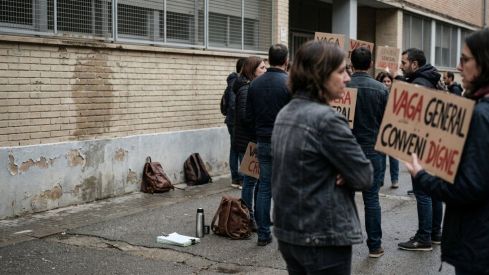
The general strike called today in Catalan public education comes after more than three months of negotiations between unions and the Department of Education, with a new meeting of the sectoral table scheduled for this afternoon. The standoff remains open despite the Generalitat having increased its salary offers and added proposals on staffing, ratios, and inclusive education.
The gap between the two parties remains at a central point. Education has gone from proposing a progressive increase of 15% in the specific complement until 2029 to reaching an agreement in March for 30% with CCOO and UGT, but the unions maintaining the strike call argue that these figures do not compensate for the accumulated loss of purchasing power nor resolve the lack of resources in schools.
Education raised the salary offer from 15% to 30% and did not avoid the strike
The first proposal presented in February contemplated a progressive increase of 15% in the specific complement until 2029. The measure affected about 97,000 teachers and was equivalent to about 100 euros per month.
Then came a second offer that raised that improvement to 25% of the specific complement. The calculation presented to the table placed the increase at about 2,500 euros per year more until 2029, with about 180 euros per month distributed in 14 payments.
In March, the Department of Education reached an agreement with CCOO and UGT to increase the regional salary complement by 30%. The pact included a global investment of 2 billion euros, reduction of ratios, resources for inclusive education, a complement for educational support staff, and 50 euros per overnight stay on school trips.
USTEC-STEs, Professors de Secundària, CGT, and La Intersindical did not join that agreement and maintained their mobilizations. Their rejection is not limited to salary, as they also demand more concrete details on calendars, guarantees of implementation, and real reinforcements in schools.
The proposal of 2,405 staff members did not convince the striking unions
Education has put on the table the incorporation of 2,405 new staff members for the next academic year, at a cost of 93.6 million euros. Of that total, 1,348 positions, 56.05%, would be reserved to reinforce inclusive education and well-being in schools.
The unions supporting the strike consider that figure insufficient and demand more resources and more detail on how the funds will be distributed. This criticism links to one of the demands they have repeated throughout the negotiation, the lack of means to cater to diversity and reduce pressure in classrooms.
Another of the department's offers included improvements in seven salary supplements with an investment of 78.67 million euros staggered over five years. The measure affected 104,591 teachers throughout the educational system, including those in subsidized private schools, but it was dropped because it did not propose a linear improvement for all staff.
The last meeting added a linear bonus of 40 euros and opened the door to sexenios
In the meeting prior to the strike, the Department of Education proposed a linear salary supplement for all teachers of about 40 euros per month. The unions positively assessed that the improvement was the same for all staff, although they maintain that the amount falls short of recovering lost purchasing power.
The department has also shown willingness to study compensation for the debt of sexenios accumulated since the 2012 cuts, when these supplements began to be paid after nine years instead of six. This point is part of the ongoing negotiation to try to bring positions closer during the day.
Back in April, the Generalitat approved an 8.5% increase in the specific supplement for 2026, along with a one-time payment in the May payroll of 839.02 euros for primary school teachers and 857.92 euros for secondary school teachers. It also set a compensation of 50 euros per night for overnight activities starting from the 2026-2027 academic year.
This afternoon's meeting should clarify whether the linear supplement and the possible compensation for sexenios are enough to halt the conflict. If there is no agreement, the calendar still has a territorial strike called in Girona for Monday, June 1, and another general strike for Friday, June 5.