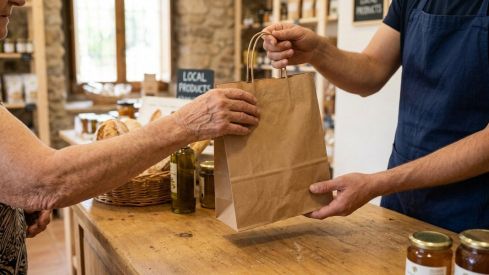
Llorà has opened the Cafè del Cau, an agro-shop café located next to El Cau de la Vall and the municipal pavilion, with the intention of covering a basic need in a community that had neither bars nor shops. The opening places the municipality on the map of formulas with which small towns try to maintain everyday services.
The contrast appears in the radiography of the Girona regions themselves. A study by Empresa i Treball based on 444 responses from 476 municipalities shows that there are 116 town councils with fewer than a thousand inhabitants in the demarcation and that, within that group, 38 micro-towns lack a food store, 13 have no catering, and 12 have neither of the two services.
Girona concentrates 17 of the 30 multiservices in Catalonia
The Cafè del Cau fits into this network of hybrid solutions that is gaining weight in small towns. Catalonia has 30 multiservices, and 17 of them are in the Girona regions, defined as establishments promoted by a local entity in a single space that combine at least two services of general interest and include food retail or catering.
The municipal magazine Banya de Boc presented the new establishment as a "new and longed-for" space in a town without bars or a shop. Its location, next to El Cau de la Vall and the municipal pavilion, reinforces its function as a meeting point and basic service in the same facility.
The implementation of these formats responds to a very fragmented municipal map. 42.6% of micro-towns are multinucleated, and the average distance to the nearest regional capital is 18.3 kilometers, a combination that complicates daily access to basic shopping or a local bar.
l'Alt Empordà and el Ripollès have the highest proportion of small municipalities
l'Alt Empordà is the region with the most micro-towns in all of Catalonia, with 48 municipalities of fewer than a thousand inhabitants, 70.6% of its local map. In el Ripollès, 14 of its 19 municipalities do not reach a thousand residents, which is equivalent to 73.7% of the total.
The presence of these municipalities also exceeds half of the local map in other Girona regions. Micro-towns represent 55.6% in el Baix Empordà, 54.5% in el Pla de l'Estany, and 52.4% in la Garrotxa, while they drop to 44.4% in el Gironès and 19.2% in la Selva.
Not everything is limited to the absence of a shop or bar. The same study indicates that 34 micro-towns in Girona sell print newspapers and 37 have a package pick-up point, a service that usually depends on Correus, municipal facilities, bars, multi-service shops, grocery stores, tobacconists, or service stations.
Palau-sator reopened service after the closure of a grocery store with more than sixty years
Palau-sator offers another example of a change forced by the disappearance of traditional commerce. Francisqueta's retirement closed more than sixty years of grocery store service and made way for El Rebost d'El Trampolí, a tasting and grocery store managed by the entity El Trampolí, linked to the integration of people with intellectual disabilities.
The municipal magazine La Senyera described that closure as a loss for the elderly and, at the same time, as an opportunity to give new life to municipal premises. In Llorà, the response has followed a similar logic, with a new space to cover services that had disappeared from the nucleus.
Of the 116 municipalities with fewer than a thousand inhabitants in the Girona regions, 12 have neither food stores nor restaurants, the highest level of deficiency identified by the study by Empresa i Treball.