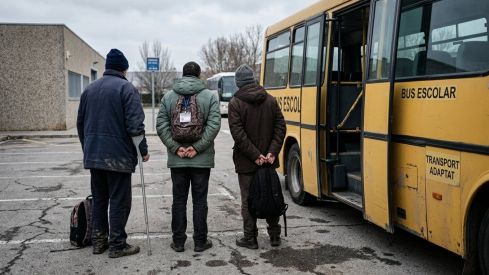
More than thirty families from the regions of Girona are demanding a stable solution so that disabled adults do not lose the transportation that allows them to reach occupational centers, special employment centers, and day centers. The conflict affects users who until now took advantage of vacant spots on existing school routes.
The breakdown occurs when these individuals still need support to study, work, or access assistance resources, but can no longer use the service upon turning 18. The Consell Comarcal del Gironès announced at the end of January that, starting next academic year, those no longer registered in the Registre d'Alumnes de Catalunya will not be able to continue on these routes.
Thirty-four families created a platform in Banyoles after the January notice
The discontent crystallized on May 10th in Banyoles, where 34 families, mainly from Gironès, Pla de l'Estany, and Selva, established the Plataforma pel Dret a la Mobilitat Inclusiva (Platform for the Right to Inclusive Mobility). Since then, the group has gathered over 2,000 signatures of support.
The platform took its complaint to the Demarcació de Girona of the Col·legi de Periodistes (College of Journalists) to warn that the loss of this resource could leave many individuals without regular access to the centers where they develop their life, social, and work projects. The families are asking to maintain the use of vacant spots on existing routes, without opening parallel lines.
Jordi Duran, spokesperson for the platform, places the problem in the daily commutes between municipalities and Girona, with cases of families traveling from Sant Hilari Sacalm or Blanes to take their children to the centers.
"Many of us are of working age and there are also many elderly people who no longer feel strong enough to drive to Girona from Sant Hilari Sacalm or Blanes" - Jordi Duran, spokesperson for the Plataforma pel Dret a la Mobilitat Inclusiva
The group maintains that the solution applied for over ten years was not a specific exception, but a provisional response maintained over time. Furthermore, they recall that families already participate in the co-payment of the service and reject the alternative of aid for finding taxis or other transportation on their own.
Families ask to consolidate a system that has been working for over ten years
Duran insists that the lawsuit is not about expanding new routes, but about preserving a mechanism already used on the same routes. Along these lines, he defends that vacant spots have already been used for more than ten years and that withdrawing this option now leaves a route that was already practically covered without coverage.
The spokesperson also warns of the impact that the suppression of the service would have on users' daily lives. For many families, he explains, organizing each day already requires balancing work, caregiving, and long commutes.
"We don't want a subsidy to manage by looking for taxis or transport, but a consolidated solution" - Jordi Duran, spokesperson for the Platform for the Right to Inclusive Mobility
In the same appearance, Duran summarized the risk with another direct warning, pointing out that some affected individuals may end up not leaving their homes. He also defended that disability does not disappear upon turning 18 and that, in fact, support needs become more visible when transitioning to adult life.
Representatives of the platform met with David Álvarez, director of Territorial Services in Girona of the Department of Social Rights and Inclusion, and with Miquel Marcé, director of Territorial Services in Girona of the Department of Education and Professional Training. The group described this meeting as positive and constructive because the administration acknowledged the problem and expressed a willingness to find a solution.
After that meeting, families received a message of reassurance for the next academic year. Jordi Duran explained that they were told to process the pre-registration for school transport while the administration works on a continuity formula, within a framework that families consider outdated because the current regulations date back to 1996.