Motorcycles and mopeds account for 41% of accidents with fatalities and serious injuries on the Girona road network analyzed between 2022 and 2024 by the RACC and the Servei Català de Trànsit. In fatal accidents, their share is also high, present in 40% of cases.
This figure contrasts with their actual volume of circulation. Two-wheeled vehicles represent only 2.1% of global road mobility, a gap that has led Ramon Lamiel, director of the Servei Català de Trànsit, to admit in Girona that "if we are concerned about any vehicle and any group at the moment, it is the motorcycle."
Half of motorcycle accidents are concentrated on 249 kilometers
The study also indicates a strong territorial concentration of risk. 50% of serious and fatal accidents involving motorcycles on the iRAP network in the Girona regions accumulate on only 20.5% of the analyzed length, approximately 249 kilometers.
The stretch with the most accidents is the B-682 and GI-682 between Malgrat de Mar and the junction with the C-63 to Lloret de Mar. Added to this corridor are the C-152 between La Vall d'en Bas and Olot, the GI-641 between Torroella de Montgrí and L'Estartit, and the N-260 between Llançà and Figueres.
Also appearing among the points with a high concentration of accidents are the C-63 between Lloret de Mar and Vidreres, the C-31 in L'Alt Empordà, several stretches of the C-65 in Gironès, and the GI-673 and GI-674 between Caldes de Malavella and Llagostera. Seven of the ten stretches with the most accidents already appeared in the previous study.
Trànsit attributes the increase to the change in mobility after the rains
Lamiel maintained that the evolution in 2026 follows a known pattern. To date, Catalonia has registered 21 motorcycle fatalities, the same figure as in 2025 and very close to the 20 in 2019, within an annual trend that usually closes with between 40 and 50 motorcycle deaths.
During his speech, the director of the Servei Català de Trànsit explained that the rains in the first quarter contained motorcycle mobility. Afterwards, with the improvement in the weather, there was a "decompression of motorcycle mobility" which, in his words, has worsened the accident rate, especially after a "very bad" May in Catalonia.
"If we are concerned about any vehicle and any group at the moment, it is the motorcycle" - Ramon Lamiel, director of the Servei Català de Trànsit
Lamiel added that a "specific and special wake-up call" is needed for this group. The focus is not limited to driving habits, but also to the response of the road network in sections where accidents are repeated.
Lane marking reaches 65% compliance
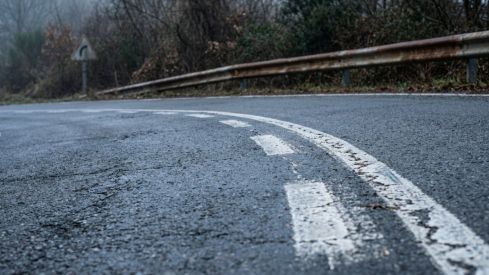
Trànsit has begun testing painted markings on the road to indicate the motorcyclist's line and facilitate cornering. One of the roads chosen for the trial is located between Ripollès and Cerdanya, two regions with high percentages of high-risk sections.
According to preliminary data from the agency, 65% of two-wheeled vehicles already respect the markings painted on the road. Lamiel argued that these signs aim to reduce run-off-road accidents due to excessive speed in curves, as well as head-on or frontal-lateral collisions due to partial invasion of the opposite lane.
The director of the Servei Català de Trànsit summarized the approach with a concrete idea. "The intention is to extend it," he stated, after emphasizing that infrastructure can help translate iRAP map diagnoses into actions on sections with the highest number of motorcycle accidents in Girona and the rest of Catalonia.