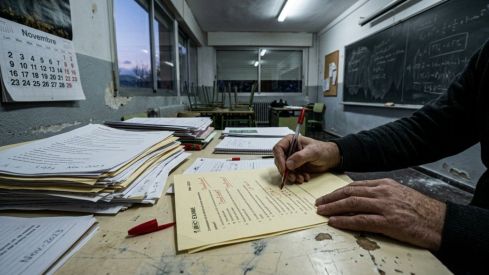
The debate about schools is once again focusing on a fundamental question: has the educational level declined, or is the system still being measured by outdated parameters despite rapid changes? The discussion arises at a time when teachers and experts are exchanging criticisms about content, demands, inclusion, and the use of technology in the classroom.
A paradox emerges from this exchange of views. While schools try not to leave anyone behind, some teachers warn that the result may be a general lowering of standards that also doesn't help those who need the most support.
María Jesús Jiménez left teaching early due to bureaucracy and stress
María Jesús Jiménez, a recently retired secondary school teacher, states that she left teaching earlier than she would have liked because the situation became unmanageable due to bureaucracy, stress, and constant legislative changes.
The teacher compares second-year baccalaureate exams from thirty years ago with current ones and concludes that her last students, whom she describes as a good cohort, would not have been able to pass those old tests. Her diagnosis is not limited to the final results but also to the type of knowledge that reaches the classroom today.
Jiménez does defend the competency-based model for subjects and content such as statistics or percentages. At the same time, she warns that foundational learning such as multiplication tables or polynomials requires memory, practice, and direct explanation.
Jordi Grané warns that inclusion without resources leaves everyone behind
Jordi Grané, a philosopher and expert in resilience, argues that the idea of not leaving anyone behind becomes a problem when the response involves lowering the bar for everyone. In his opinion, inclusion without sufficient resources ultimately leads to no one progressing.
"Educating is being there without being over them" - Jordi Grané, philosopher and expert in resilience
With this approach, Grané argues that educating is not equivalent to doing for children what they can already do themselves. His perspective aligns with a broader critique of adult over-intervention in learning and autonomy processes.
He also places technology in this context. Grané calls the current digital environment an algorithmic regime and reminds us that to properly use a tool that mixes information and disinformation, one must first know how.
Artificial intelligence is useful as support if it doesn't replace the effort of thinking
Both Jiménez and Grané agree that artificial intelligence can be useful in the classroom when used with judgment and knowledge. The risk, they point out, arises when students turn it into a shortcut to avoid intellectual work.
The discussion, therefore, does not revolve solely around the presence of new tools, but around the type of learning that lies behind them. Here, the defense of more competency-based methods coexists with the demand for knowledge that requires repetition, memory, and direct teacher support.
The podcast Sobre (vivir) a la crianza, which collects these reflections, is published every Sunday on Spotify, Ivoox, Apple Podcast, Podimo, Amazon Music, and Youtube.