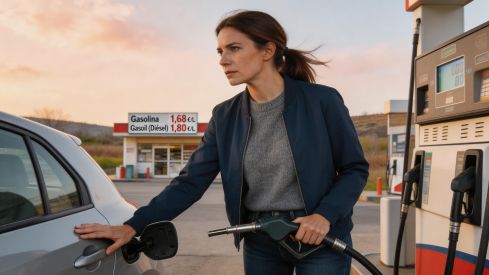
Since last March 4, refueling diesel in the regions of Girona has been more expensive than filling the tank with gasoline. The price increase affects thousands of drivers and is reflected in service stations throughout the province.
Historic rise after the attack in Middle East
The price of diesel has experienced an increase of 23.2% and stands at 1.808 euros per liter on average, while gasoline has risen 12.5% to 1.682 euros per liter, according to data from the Ministry for Ecological Transition. Currently, diesel is almost 13 cents more expensive than gasoline, which means paying 6.3 euros more to fill a 50-liter tank.
The increase occurs after the joint attack by the United States and Israel on Iran, on Saturday, February 28. Since then, the price of oil has exceeded 90 dollars per barrel, almost 50% more than the value recorded before the conflict.
International and fiscal factors in the price increase
The evolution of prices in Girona is directly related to the international price of crude oil and refined products. Inés Cardenal, spokesperson for the Spanish Fuel Industry Association, explains that diesel pays 10 euro cents less per liter in Spain in terms of special hydrocarbon tax than gasoline. However, the tax difference does not compensate for the current rise.
"The price of refined diesel has risen much more than that of gasoline, so it stops being compensated through taxes" - Inés Cardenal, Spanish Fuel Industry Association
Cardinal attributes the increase to China's decision to ban exports of refined products and to supply restrictions derived from the situation in the Strait of Hormuz. This maritime passage separates the Arabian Peninsula from Iran and through it transits 25% of the world trade in crude oil and derivatives.
Impact on industry, agriculture and transport
Martí Pachamé, professor at EAE Business School, highlights that diesel reacts with more violence to international conflicts because, unlike gasoline, it is used intensively in industry and agriculture. Diesel is essential for sectors that cannot stop their activity, which increases pressure on prices in times of uncertainty.
"Diesel tends to react with more violence to conflicts because, unlike gasoline, the use of which is limited to cars, it is highly sought after for other activities, such as industry and agriculture" - Martí Pachamé, EAE Business School
Víctor Ruiz Ezpeleta, professor at OBS Business School, adds that European refineries are more specialized in gasoline than in diesel, which forces the import of a significant part of already refined diesel. This external dependence worsens the situation when there are international restrictions.
"Diesel is a highly sought-after product for industry, agriculture and transport, activities that do not stop and, when there are oil restrictions, its price rises more because the demand to make provision of this product is higher" - Víctor Ruiz Ezpeleta, OBS Business School
Supervision of prices and possible speculative practices
Ruiz Ezpeleta points out that there is a speculative factor on the part of some service stations, although he also recognizes that many suppliers have raised the price of their products in anticipation of buying more expensively in the immediate future. The Minister for Ecological Transition, Sara Aagesen, has commissioned the CNMC to monitor the evolution of these prices to prevent possible bad practices by the companies.
- The price of diesel in Girona already exceeds that of gasoline by almost 13 cents per liter
- The price increase especially affects those who depend on private vehicles and productive sectors
- The CNMC's monitoring seeks to guarantee transparency in price formation