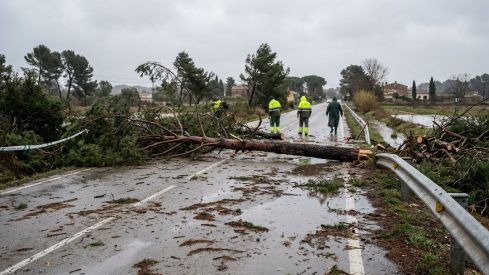
Girona has chained together in 2026 three consecutive months of distinct and overlapping meteorological episodes, with a January of rains, snow and sea storm, a February marked by severe gales and a March with a DANA of intense rains and new tramontanadas. The succession of storms has left records well above the usual in several points of the demarcation and has once again put the focus on the recurrence of extreme phenomena.
January closed as one of the rainiest of the series
AEMET classified January 2026 in Catalonia as a very wet month. The average precipitation was 137 millimeters, 292% of the reference value, and ranked as the fourth wettest January since the beginning of the series. In Girona, the accumulated amounts were especially high in L'Estartit with 224 millimeters, Girona Sant Daniel with 219.5 and Castelló d'Empúries with 182.4.
In Empordà there were areas that exceeded 450% of the normal precipitation value during that month. Meteocat attributes this behavior to the dominance of Atlantic lows and the westerly zonal circulation, in a context of great atmospheric dynamism.
Between January 16 and 20, an episode of extensive precipitation was recorded in Catalonia. Within that period, on the 18th and 19th, a levante storm hit especially the Costa Brava, where punctually over 200 millimeters were exceeded in 24 hours. Afterwards, between January 24 and 28, another depression left more than 50 millimeters in the Alt Empordà.
The snow complicated the Pyrenees and left very high thicknesses
January was also accompanied by snow in the Pyrenees. Meteocat places a snowfall on the 9th and 10th and another between the 16th and 20th. During this last episode, more than half a meter accumulated in the high Pyrenean mountains.
At the end of the month, AEMET measured 230 centimeters of snow in Vallter 2000 and 148 centimeters in Núria. A few days later, Meteocat recorded 144 centimeters in Núria, a record for its series, and 280 centimeters in Vallter. The snow complicated access to Vallter during the easterly storm.
February changed the rain for severe wind storms
The atmospheric dynamism did not stop in February. AEMET points out that the main impact in Catalonia came from wind storms associated with low-pressure systems NILS, ORIANA, and PEDRO. Between February 10 and 19, strong wind episodes occurred consecutively, in a period that the report describes as severe storms and extraordinary atmospheric activity that season.
On February 14, with storm ORIANA, a gust of 172 kilometers per hour was recorded in Portbou. Two days earlier, on February 12, the Govern limited unnecessary mobility and suspended non-urgent educational and care activities due to an extreme risk of gales. That same day, the R11 line was interrupted between Girona and Maçanet Massanes due to a fallen tree, and a man injured in Sant Pau de Segúries was admitted in serious condition to Trueta hospital.
Facing the excesses of January, February left very scarce precipitations in the interior of Girona and a pluviometric deficit in a good part of the demarcation. At Girona airport, the average monthly temperature was 11.2 degrees.
March brought a DANA and two tramontanadas with falling of trees
March turned the pattern again. Meteocat describes it as a month marked by the dominance of the zonal flow from west to east and by isolated disturbances aloft, with a DANA that between March 5 and 8 left more than 200 millimeters in sectors of La Garrotxa and Alt Empordà.
In that episode, 260.9 millimeters were collected in Lliurona, 229.3 in Santa Pau and 202.2 in Batet de la Serra. For the month as a whole, the most notable records in Girona were 318.3 millimeters in Lliurona, 264.4 in Santa Pau, 253.5 in Sant Pau de Segúries, 245.1 in Molló Fabert, 237.4 in Batet de la Serra, 225.8 in la Vall de Bianya and 225.4 in Mieres.
March also included two tramontana winds, on the 15th and 29th, with hundreds of trees falling in the territory. Meteocat highlights that 100 kilometers per hour were exceeded in several points. The climate bulletin for that month specifies 167.4 kilometers per hour in Portbou coll dels Belitres on the 15th and 168.5 on the 29th.
A pattern that fits into the growing weight of meteorological disasters
The succession of storms in Girona coincides with the trend gathered by the study 75 years of disasters in Spain, prepared by the University of Oviedo, which analyzes 550 disasters. That work indicates that hydrometeorological and climatological phenomena represent approximately 39% of the total. It also places the annual average at 20.2 disasters between 2011 and 2020 and at 14.2 between 2021 and 2025.
In Girona, the start of 2026 leaves for now an unusual sequence due to its continuity and due to the variety of episodes, with extreme rain, persistent snow and gales in barely three months.