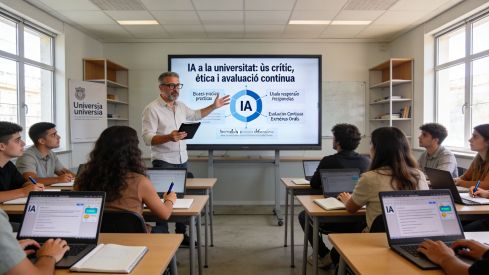
The public universities of Catalonia have integrated artificial intelligence into their study plans and into the daily activity of the classrooms, affecting the way in which students perform assignments and exams in Barcelona, Girona, and Tarragona.
The AI in teaching and assessment
The use of artificial intelligence tools is already a reality in Catalan faculties. Students can use these systems to solve academic tasks, always under codes of good practice and with the warning of sanctions in case of fraud or improper use. Continuous assessment, oral exams, and active listening in class have been reinforced to guarantee effective learning.
At the Universitat Pompeu Fabra, located in the Ciutat Vella district of Barcelona, the implementation of AI has been accompanied by intensive training for the faculty. The deans decide how to apply the technology according to the degree program. Sergi Torner, vice-rector of Planificació Acadèmica, emphasizes the importance of training students for a professional environment where AI is a protagonist.
"At the university, we train students who will work in a world with AI. It's not that they learn despite AI, but that they learn with AI" - Sergi Torner, Universitat Pompeu Fabra
At UPF, the exams have changed. Syntheses of articles are no longer requested, but rather it is requested to apply theories and solve concrete problems. According to Torner, this adaptation responds to the current technological reality.
Autonomous Decisions and Transparency in the UAB
The Universitat Autònoma de Barcelona, after two years of teacher training, allows each professor to decide how to incorporate AI into their subjects. Transparency is a key principle. Students must explain how they have used AI in their work and for what purposes. The final result and responsibility for the content rest exclusively with the student.
"Transparency means that, when doing an assignment, students must explain how they have used AI and for what purpose. We don't want it to be used secretly, but with good judgment" - Ramon Vilanova, Universitat Autònoma de Barcelona
In case of improper use of AI, the UAB contemplates sanctions in the evaluation of the subject.
The Universitat de Barcelona strengthens oral exams
At the Universitat de Barcelona, located in the Eixample, oral exams have increased in all faculties. Xavier Triadó, vice-rector of Política de Digitalització, defends that the tests must verify real learning and not the simple repetition of content.
"Tests should not be given for students to repeat things, but to check what they have learned" - Xavier Triadó, Universitat de Barcelona
Triadó recommends to his students to write class summaries by hand and to use AI as support, but never as a substitute for their own work.
The UPC bets on the ethical and flexible use of AI
The Universitat Politècnica de Catalunya allows the use of AI in specific parts of exams and subjects. Cecilio Angulo, delegate of the rector for AI, highlights the importance of an ethical and skillful use of these tools to improve academic effectiveness.
"We do not stop or censor. Educating by prohibiting is easy, the complicated part is educating by allowing. A large part of society has demonized AI and that is a mistake" - Cecilio Angulo, Universitat Politècnica de Catalunya
In final degree or master's projects, UPC recognizes that students can receive AI help in writing, but the content and conclusions must be their own.
The implementation of artificial intelligence in Catalan universities is under supervision and regulated by internal rules. Each center adapts the technology to its needs and contexts, with the aim of preparing students for a labor market where AI is already an everyday tool.