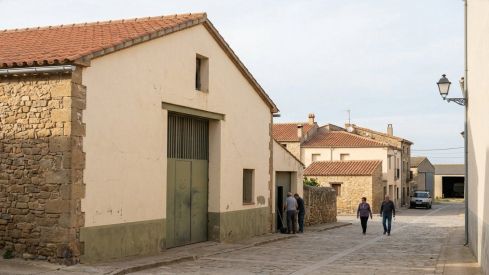
The Government has approved a decree that streamlines urban planning procedures in municipalities with fewer than 2,000 inhabitants in Catalonia. The rule allows existing constructions on non-developable land such as farms or warehouses without patrimonial value to be used for housing to combat depopulation.
This measure will directly affect 191 town councils in the province of Lleida. This figure represents 80 percent of the total municipalities in the demarcation. The stated objective is to facilitate the development of housing projects where it was previously unviable.
Town councils will inventory recoverable buildings
Each town hall must approve a specific inventory of buildings on non-developable land that are suitable for conversion into a habitual residence or for economic activities. This list will be independent of the existing farmhouse catalog.
The actions foreseen under this new figure will require only the municipal license. The need to obtain a prior report from the Territorial Urban Planning Commission of the Generalitat is eliminated. In addition, extensions of up to 150 square meters are authorized provided that their landscape integration is justified.
"addresses the housing problem and facilitates settlement in villages" - Jaume Gilabert, mayor of Montgai and president of Eines de Repoblament Rural
The standard also establishes the figure of rural neighborhoods. This category applies to nuclei located on non-developable land with an accredited age of at least 100 years. It seeks to regularize historical settlements that lacked a clear legal framework.
Approval deadlines are reduced to two years
The decree creates the Rural Municipal Urban Planning Plan. This instrument will be subject to a simplified environmental assessment and will require less technical documentation. Planning regulations are also introduced, which the town councils may approve after receiving a binding report from the territorial commission.
These changes drastically compress administrative times. Planning approval deadlines go from oscillating between 7 and 10 years to being reduced to 2 years. This acceleration aims to boost the supply of land in stagnant rural areas.
The councilor Sílvia Paneque highlighted that the text enables rural municipalities to jointly contract the project and execution of public and building works. This route seeks to improve spending efficiency in territories with less own technical capacity.
In parallel with the regulatory approval, the Catalan executive has opened a call for tenders for 8 public plots. The plots are located in Baix Pallars, Bellver de Cerdanya, Llavorsí, Rialp, Vielha, Balaguer and Juneda.
These lands have the capacity to build 142 affordable rental housing units. The initiative complements administrative simplification with a direct offering of public land in seven key locations in the interior and the Pyrenees.