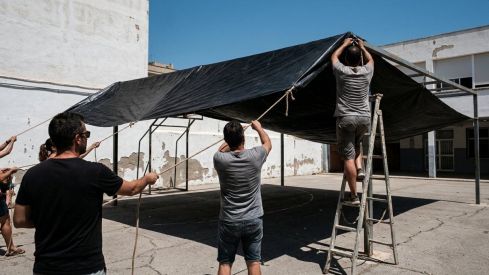
The families of Escola El Miracle have again installed awnings at the center to protect the students from the sun in the playground after the dining room and on the windows of some classrooms. About thirty parents put up fifteen black tarpaulins this weekend due to the lack of structural solutions in the building.
The scene repeats for the second consecutive year in a context in which there is no legal regulation that guarantees adequate thermal comfort conditions for the student body, although there are for teaching staff and other adults in the workplace. The gap between this absence of protection and the predicted increase in heat episodes concentrates part of the families' discontent.
Thirty families placed fifteen black tarps at Escola El Miracle
The action was driven by the center's parents' association, which disseminated two protest messages on Instagram. In that publication, the AFA maintained that families should not assume this task and directed direct criticism at those responsible for the administration for the lack of measures in the classrooms and outdoor spaces.
Thirty families installed fifteen black tarps this weekend.
The complaint comes after the same measure was already used last year. The intervention seeks to reduce sun exposure both in the patio located behind the dining room and in several classroom windows, two points in the center especially affected by direct sunlight.
Equitat.org estimates 1,220 public buildings without climate adaptation
The case of Escola El Miracle coincides with the publication of the report 1,220 out of 2,500 public buildings are from before the year 2000 and have not received climate adaptation reforms, according to the Equitat.org foundation. The document analyzes the capacity of the public network to respond to a scenario of higher temperatures and longer warm periods.
Ismael Palacín, director of Equitat.org, summarizes that mismatch between buildings and the current meteorological reality.
"The country's schools were designed for a climate that no longer exists" - Ismael Palacín, director of Equitat.org
The study predicts that from 2030 onwards, educational centers will register between 22 and 65 days a year with temperatures above 27 ºC, depending on the territory. This increase in sustained heat days affects both ordinary classroom activity and the use of playgrounds and other shaded areas.
From 2030 there will be between 22 and 65 days above 27 ºC.
Equitat.org adds that prolonged exposure to heat harms academic performance and various cognitive functions. The report links these conditions with poorer reading comprehension, lower neuronal activity, and memory problems among students and teachers.
The foundation proposes a plan for the adaptation of educational centers within a period of five to ten years. Its proposal places the investment below 130 million euros annually, an amount it calculates at less than 200 euros per student per year.