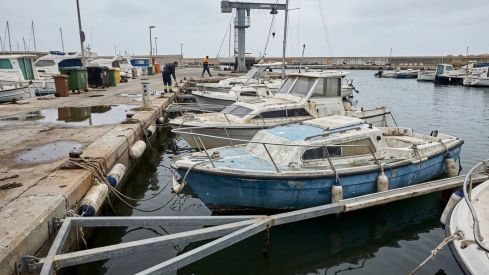
The marinas of Girona and the rest of Catalonia face a silent but devastating crisis caused by abandoned vessels. The lack of space combines with the imminent risk of polluting discharges in waters that support one of the highest densities of moorings in the Mediterranean.
Catalonia has nearly 30,000 moorings distributed along its coasts, a scarce resource that is blocked by ghost ships. The abandonment mainly affects small and medium-sized recreational boats, between six and ten meters, which usually fly the Spanish or French flag.
A parking lot of dead cars
The situation generates direct economic frustration for the managers of maritime facilities. Jordi Caballé, of Marinas de España, describes the reality starkly by comparing these spaces to a parking lot where users disappear.
"It's like having a parking lot where several people leave their car and disappear forever. You have a spot occupied without being able to charge" - Jordi Caballé, Marinas de España
This analogy reflects the powerlessness of ports in the face of the impossibility of passing on costs or freeing up berths. The absence of an official census prevents an exact quantification of the real scope of the problem, although indicators point to sustained growth.
Deterioration threatens the docks
The inaction of the owners triggers an accelerated degradation process. Saltpeter and storms quickly damage the structure when basic maintenance ceases. Those responsible in the sector warn that the hull degrades to the point of compromising the safety of the entire marina.
There are waterways that lead to a risk of sinking. When the ship's defenses break, the vessels impact the dock and damage adjacent boats. There is even a danger that a drifting ship will drag another during a storm.
"We have to carry out surveillance rounds to control these boats. When we see that their waterline is below the water, we have to act" - Carles Fillat, Consorci Port de Mataró
Carles Fillat, manager of the Consorci Port de Mataró, estimates about twenty boats in poor condition at his facility. This scenario is repeated with greater intensity on the Central Coast, from Maresme to Garraf, where some facilities accumulate up to 30 abandoned units.
Bureaucracy slows down scrapping
Administrative slowness aggravates the conflict. Between 2020 and 2025, Puertos de la Generalidad processed 68 abandonment files, which represents an average of 13 to 14 annually. However, the eight new files opened in the first four months of 2026 alone indicate an alarming acceleration.
This data suggests that this year practically half of what was managed in the previous five years combined will be processed. Added to this saturation is the legal complexity. The entire administrative procedure for removing and destroying the ships adds two more years of waiting after the initial intervention.
Lluc Puig, director of Marina Empuriabrava, points out that there are cases of boats that go up to five and six years without facing mooring costs. For a small eight-meter boat, the amount not collected can range between 3,300 and 8,000 euros annually.
Million-dollar debts and urgent solutions
The management of appraisal, expert reports, lawyers, transport, and dismantling can mean at least 4,500 euros more in costs for the port. Empuriabrava carries out between six and eight dismantling operations per year, but the financial burden is unsustainable for many entities.
Puig proposes to defaulting owners access to the scrapyard in exchange for forgiving part of the incurred debt. Three years ago, the manager removed the vessel Margarita at the Portbou Port Consortium after it sank off the port. After removal by crane, two years of procedures passed before it could be definitively scrapped.
The root of the conflict lies in demographic and social factors. Laureà Fanega, president of the Barcelona Nautical Capital Foundation, indicates that it is a problem that is growing due to the aging of owners and the current fleet. Raimon Roca, president of the Catalan Association of Sports and Tourist Ports, adds that heirs who neglect the vessel and owners experiencing economic difficulties are influential.