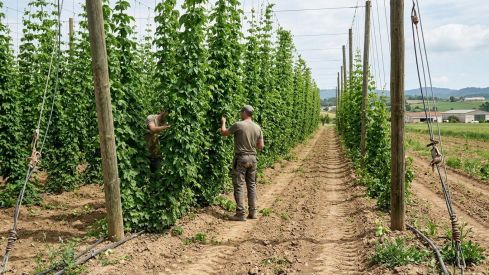
Albert Vilardell cultivates organic hops for 13 years and has converted a first test on a family plot in Crespià into a project that today also extends to Lliçà d"Amunt and Llagostera. His venture is part of Biolupulus, a brand that groups 12 producers from Catalonia and Castilla y León and cultivates 32 hectares with a common objective, to produce a local and quality hop with a land-respectful management.
Vilardell summarizes the profile of the product he obtains with a clear idea. He defines it as a hop "sweeter, smoother and with citrus and herbaceous notes that provide a differential touch to the beer". That search for nuances is based on a cultivation model that, he argues, prioritizes the biological cycles of the plant and soil fertility.
From Crespià to a network of producers
The farmer started cultivating in 2013 on a family farm in Crespià. After that first harvest, he assures that "I did four numbers" and saw that the project could have a journey. Later on, he opted to associate with other producers. "It made no sense to be alone when you can share and learn," he explains about that step.
Over time, the project has incorporated new plots in Lliçà d"Amunt and a third in Llagostera. As of today, Biolupulus brings together a dozen producers who work under the same way of doing and share criteria on the organic cultivation of hops.
A crop that starts in April and is harvested at the end of August
The hop cycle begins in April, after the winter rest. Vilardell points out that since November the plants have been hibernating and that, with the arrival of spring, they begin to wake up and gain height. In three weeks they reach one meter and twenty and then they need about a month to reach the top, up to six and a half meters, before developing sideways and flowering.
The harvest is concentrated at the end of August, when the plant has already accumulated the resin that provides aromas and bitterness to the beer. The moment is key. Vilardell warns that if the harvest is delayed, vegetable aromas appear that leave an aftertaste of garlic and onion that they want to avoid.
Ecological management and biodiversity conservation
The producers take into account the entire crop ecosystem. In that work, worms, insects, and rabbits are included, as well as the herbs that grow around each field. On the farms there is also livestock. Vilardell explains that they have animals like horses because their manure helps manage the plant cover.
Biolupulus also participates in a conservation project of the l'Albera goat of Catalonia, an endangered species. On their farms, they keep some of the last remaining specimens.
Facing the industrial model, Vilardell maintains that they have respected the biological cycles of the plant without intervening in a hostile way. Their work system, he details, seeks to make the land more fertile so that the hops grow without the need to till or apply products. In his opinion, in industrial hops there are aromas that are masked, probably due to the quantity of phytosanitary products used, while in organic hops they detect sweeter, more pleasant profiles with well-defined citrus notes.
The Lolita variety and the market launch
Biolupulus cultivates the Lolita variety, unique throughout the Peninsula and developed by the brand itself through an artisanal genetic improvement process. Vilardell assures that it not only presents a balsamic profile, but also provides a freshness that encourages the consumer to drink another beer. Along with this variety, they also work with Chinook, Pacific Gem, and Cascade.
Once harvested, the hops are dried to be able to market them. Most of the production goes abroad. 98% is destined for Germany, Italy and also Chicago, among other markets, while 2% remains in Catalonia. The brand tries to increase this local share with initiatives such as the Harvest cup, which this year will celebrate its third edition. In it, brewers come to collect the hops and incorporate them directly into their production to later launch a beer on the market.
Among the Gerundense brands that already work with this organic hop are Rufa, Moska, Dos Kiwis, G Brewers and Rispa. Vilardell assures that the reception is positive and that, at least for the feedback they receive, these beers are working well among consumers.
Ultra-freezing to extend the life of fresh hops
This year Biolupulus has started to ultra-freeze organic hops to obtain a long-lasting fresh product. The objective is to give more margin to processors for a second production and, at the same time, avoid drying, with the cost and energy consumption savings that this entails. The system also makes it easier for external producers to work with fresh hops.
Vilardell frames this evolution within a constant learning process. He recognizes that there have been 13 years of errors and adjustments. They started harvesting by hand and over time bought peelers, two in each field. In that personal journey, the farmer asserts the effort invested and links it directly to his way of understanding the trade, with the care of the land as a priority and with the will to consolidate a local organic hop that also gains importance in Catalonia.