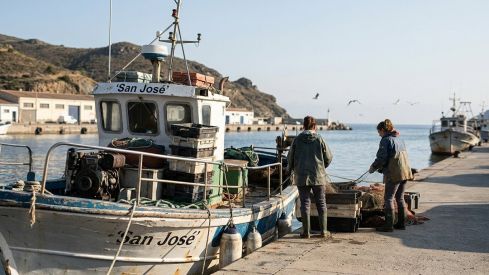
The artisanal fishing of Cap de Creus has found in the short film La Prona a window to show the lack of generational replacement and the difficulties of an increasingly fragile trade. The piece, directed by filmmaker Maria Contreras, has premiered in Barcelona and will follow a festival circuit for the next two years, with a screening scheduled this summer in Port de la Selva.
The film lasts 18 minutes and has been shot in Cap de Creus, Llançà, Cadaqués and Port de la Selva. At the center of the story appears Elena Manera, 29 years old, skipper of the artisanal fishing boat San José in Port de la Selva and fourth generation of a family linked to the sea.
A trade with fewer and fewer replacements
Manera puts the focus on the situation that the sector is going through. It warns that young people are moving away from fishing due to the lack of prospects and due to the economic difficulties that small boats drag.
"Young people do not want to enter the sector because there are no incentives or economic profitability, and the boats are old and expensive to maintain and you have to sail further and further to find fish" - Elena Manera, skipper of the San José vessel
The fisherwoman maintains that this combination of factors is pushing many coastal professionals to the limit. Manera warns that generational replacement is almost impossible and that numerous traditional boats and trades are in danger of disappearing.
Break barriers in a historically masculinized environment
The protagonist of the short film also vindicates the role of women in the sea. In her case, she highlights the support received within her own family to make her way in a job historically associated with men.
"My father always gave me the opportunity to break these barriers and show that it is not a man's job, that it is not a job where you have to be super strong and that the sea is not a matter of gender" - Elena Manera, skipper of the San José vessel
Alongside her appears Pat Bros, 39 years old, Manera's fishing partner and high school teacher. Both convey in the film the daily routine of artisanal fishing without artifice or discourses alien to direct experience.
"Everything we show is our life, our work, with the truth of each day at sea" - Pat Bros, fishing partner of Elena Manera
Conciliation and the lack of support aggravate the crisis
Bros exposes another of the difficulties that condition the continuity of the trade. She explains that this year she cannot go fishing due to the lack of real options to reconcile work with the care of her young daughter, in a family context also marked by her husband's 24-hour shifts.
"This year I can't go fishing because my daughter is small and work-life balance is almost impossible. My husband has 24-hour shifts and there isn't enough family support" - Pat Bros, fishing companion of Elena Manera
Economic instability also forms part of the diagnosis that the fisherwoman makes. She defines it as a daily race to sustain income without any guarantee.
"You have to juggle to earn a decent living, because there's nothing secure. No day is secure" - Pat Bros, Elena Manera's fishing partner
Criticism for the lack of investment in the artisanal fleet
Bros also questions the lack of institutional support for the modernization of artisanal fishing. He denounces the contrast between the resources allocated to maritime surveillance vessels and the aging of the boats with which many professionals in the sector continue to work.
"We see spectacular vessels, financed with public money, destined for maritime surveillance in areas such as the Mossos d'Esquadra or the Agents Rurals, while we continue working with boats from the seventies and old engines. We have presented sustainable projects, with electric boats and very well-prepared prototypes, but the support we need does not arrive. This is not just an economic injustice; it is a real threat to the continuity of the trade and our maritime culture" - Pat Bros, fishing colleague of Elena Manera
La Prona is thus presented as a brief but direct portrait of an activity that remains alive on the coast of Alt Empordà, although increasingly with more obstacles. After its premiere in Barcelona, the forecast is that the film will continue circulating through festivals and return this summer to Port de la Selva, the same scenario where the story it tells is still fought every day in the sea.