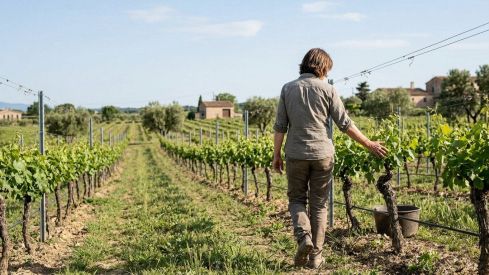
Anna Espelt will participate next Thursday, May 7, in Girona in the 3rd edition of the Nit de la Dona, a gala that will be held at seven in the evening at the Carlemany hotel and in which the winemaker will focus on the role of women in the agricultural world and on a form of leadership linked to the land, intuition, and female role models.
Espelt, linked to a family saga of eight generations tied to the vineyard and the olive tree, claims its own perspective on business and rural leadership. Her intervention will arrive at a moment in which she also defends the need to make visible female trajectories that for years have remained in the background, many times associated with administrative tasks or less publicly exposed.
A voice from the rural world with family references
The businesswoman assures that her grandmother was key in the birth of the winery more than 20 years ago and places her, along with her great-grandmothers, among her main references. From that experience, she maintains that making her way in the agricultural and business sector has required adaptation and learning.
She recalls that, at the beginning, in many meetings there was a majority presence of men and that she had to adapt to that reality. She explains that, in that process, she became masculinized to fit into certain environments and emphasizes that respect, in her case, she has had to earn it.
"You must accept reality as it is and work to change it" - Anna Espelt
In that journey, she participated in a program of the Generalitat aimed at helping middle managers to lead projects. The diagnosis she received, she points out, pointed to three frequent deficits among women, such as training, the lack of role models, and the need to learn to communicate better. From there, she pursued an MBA, entered a mentoring project, and received specific training in communication.
Claim for real equality and rejection of the superwoman model
Espelt maintains that, in general terms, women still have to prove more than men. Faced with that demand, she launches a direct reflection on the standards of excellence that fall upon them and demands that they not be required to be perfect.
"I aspire for women to be able to be as mediocre as men" - Anna Espelt
It also dwells on the personal cost that often accompanies professional careers. She explains that she was able to develop a good part of her career because the father of her daughters left his job to dedicate himself to caring for them. That exchange of roles, she states, made many things possible, although it was not without costs. That is why she rejects the idea of the superwoman as an ideal and considers that one should not aspire to that model.
In the field of family business, she points out two clear advantages. The first is the possibility of planning in the very long term. The second, that announcing a pregnancy is not experienced as a problem, but as welcome news.
Leading from the earth and intuition
The winemaker defines her way of leading as a practice rooted in the territory. Working with nature, living the cycles, and performing physical tasks are part, in her opinion, of a way of understanding the company and life. She considers it valuable to touch the earth and do real things, and defends that the more connected a person is with that environment, the further they can go.
His/Her commitment to sustainable viticulture, he/she adds, can also be read as a different way of leading, more focused on caring for the land and strengthening the connection between people. Along those lines, he/she maintains that each person contributes different things and that the debate should not be limited to men and women, but to the specific capabilities of each one.
It also raises the need to develop both the masculine and feminine parts of each person. That implies, he explains, working from reason, but also from intuition, to achieve a more global vision.
Visibility, sorority and relay in the field
Espelt believes that in the rural environment profound changes are occurring, although at a slower pace than in other sectors. In an association of women from the rural world, she explains, she was able to verify through statistics that the percentage of female farmers and peasants with higher education and working in organic farming soared in the case of women.
It also observes the arrival of new generations who approach the countryside from other areas, not only by family inheritance. It speaks of people who seek a change of life and considers that this incorporation gives vitality to the sector. It specifies, furthermore, that it is not only about women.
Regarding the valuation of female talent, she points out that there are always the women who appear and those who do not appear. In many cases, she says, they have ended up assuming the bureaucracy and the less visible tasks. In her career, the differential trait has been precisely being at the forefront and being visible.
The gala will be held at the Carlemany hotel in Girona with the sponsorship of Toni Pons, Grup Pous, Volvo Turismes Girona, l"Associació Gironina d"Empresàries, Ormetal and Centre Verd, and with the collaboration of INET, Prat Sàbat, Xuixos Can Castelló and Institut Guinot.
Ahead of the meeting, Espelt places sorority as a central idea. She argues that women need opportunities and spaces to meet, share, and inspire each other. In her opinion, events like this or even brief meetings serve to weave those connections that for a long time men have naturally had. For her, that shared time is not accessory, but a source of energy and a concrete way to build a better world.