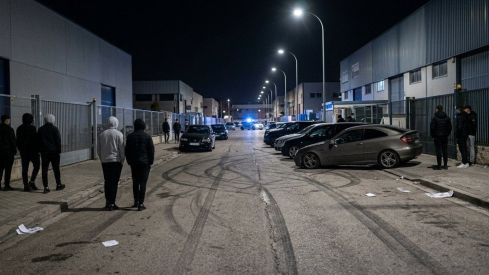
A man was seriously injured in the early hours of April 4 in the Los Olivos industrial estate in Getafe, Madrid, during an illegal car race in which he even proposed marriage to his partner in the middle of the gathering. The moment was interrupted when one of the participating vehicles left the track and ran him over. The victim was transferred to the hospital with a traumatic brain injury with a serious prognosis.
A widespread phenomenon and without official record
The Getafe episode adds to a chain of clandestine gatherings and races detected in recent months in different parts of the State. At the beginning of January, a gathering in the Somonte industrial estate, in Gijón, ended with a 19-year-old young man arrested after running over and injuring nine people.
In the last 12 months, security forces have had to dissolve illegal gatherings, and even carry out mass arrests, in territories such as La Rioja, Málaga, Granada, Toledo, Vitoria, Pontevedra and Las Palmas de Gran Canaria. In Catalonia, the last major action cited took place in industrial estates in Lleida, where 33 drivers were reported.
Police interventions place this phenomenon at a peak point during 2025, with cases reported in almost all autonomous communities. Even so, there is no global figure because there is no official record. The lack of a state-level control is also explained by the distribution of traffic competencies within the municipalities, which usually falls to the local police forces.
Peripheral polygons and calls by messaging
The calls arrive almost always through Telegram channels and, sometimes, also through Whatsapp. The pattern repeats itself. They usually take place at dawn, during the weekends, in peripheral industrial estates with deserted streets, long straightaways and wide asphalted surfaces.
One of the most crowded examples occurred in the Bell lloc industrial estate, in Lleida, where nearly a thousand participants and about 300 cars were summoned. Similar situations have also been detected in the Guadalhorce industrial estate in Málaga, in Jundiz, in Vitoria, in Mercagranada, in Los Olivos de Getafe and in O Campiño, in Pontevedra.
During the weekend of April 14-15, two recent races were also held in the polygons Villaluenga Yuncler, in Toledo, and Díaz Casanova, in Las Palmas de Gran Canaria. In the case of the race aborted by the Guardia Civil on April 4 in Agoncillo, in La Rioja, among those identified there were people residing in Cataluña, Aragón and the País Vasco.
Lleida and Asturias, two points of reference
In Asturias, the most talked-about event in recent dates was that of the Somonte industrial estate, which resulted in nine injured by being run over. There, some wooded areas on the outskirts and the Altó del Infanzón, a mountainous area with pronounced curves, are also pointed out as usual scenarios. The Guardia Civil has imposed 140 fines in the last year in controls carried out at that point.
The increase in sanctions coincides with an increasingly sophisticated organization. The calls are more striking, with higher impact videos disseminated on their own channels and social networks. That greater exposure has brought another change, the presence of drivers arrived from other provinces.
Those who follow this type of gatherings also insist on differentiating these meetings from tuning meet-ups. The distinction is relevant because a tuned car responds to aesthetic modifications in the bodywork to gain spectacularity, not speed.
Difficulties to pursue them and usual punishment
The police pursuit of these clandestine races is complicated by the absence of a national registry and by competential decentralization. In practice, detecting a call in time requires tracking their channels on social media and messaging groups, since it is not feasible to deploy patrols preventively in all the points where they can end up meeting.
In the criminal sphere, the facts can fit into Article 380 of the Penal Code, for reckless driving, or in 381, when there is an extreme risk or contempt for the lives of others. The foreseen penalties reach up to two years of prison in the first case and up to five in the second. However, in most situations, except when there are injured parties, neither that extreme risk nor the race itself can be proven with sufficient solidity and the matter ends up through the administrative route.
There, the most frequent are fines of up to 500 euros and the loss of 6 points from the license, in addition to possible additional sanctions for speeding, illegal vehicle modifications, or alcohol or drug consumption. In practice, the most common outcome continues to be economic and not penal, even in a context in which these clandestine gatherings have multiplied and gained visibility throughout the country.