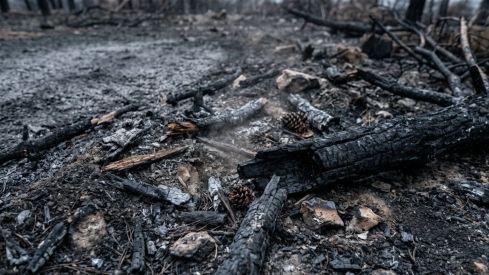
The 2025 fire season has left 1,079,538 hectares burned in the European Union, the highest figure recorded by the European Forest Fire Information System.
Spain has led the balance with nearly 401,000 hectares, while in Portugal about 284,000 burned. The paradox is that almost half of the European fire was concentrated in just two countries during a few weeks.
Twenty-two large fires burned 460,585 hectares in August
The European Commission's Joint Research Centre places the start of the campaign before the end of March, with more than 100,000 hectares already affected in the European Union. Afterwards, the fire intensified in June and reached its peak in August.
During the first three weeks of that month, a heatwave activated 22 large, almost simultaneous fires in Spain and Portugal.
Those fires ravaged 460,585 hectares, 43% of the entire surface burned in the European Union that year.
In number of fires, Italy led the list with 1,910, ahead of Spain, with 1,359, and France, with 1,312.
Human ignition explains 90% of fires with known origin
The European Forest Fire Information System mapped 7,783 fires in 25 of the 27 member states. Only Luxembourg and Malta did not register affected area.
Between 2019 and 2023, 68% of fires with a known origin were accidental and 24% intentional.
This leaves a clear majority of human ignition in around 90% of cases with an identified cause.
The Natura 2000 Network concentrated approximately 39% of the burned area in the European Union, with 424,023 hectares affected.
In Spain, almost half of the burned area was scrubland, a fact that dismantles the idea that eucalyptus and pine alone explain the disaster.
Galicia and Castilla y León suffered some of the most serious episodes, with fires that exceeded 10,000 hectares.
Víctor Resco de Dios, professor of Forest Engineering and Global Change at the Universitat de Lleida and researcher at Agrotecnio, relates the increase in vegetal fuel and climate change to a stage of fires that can no longer be extinguished with usual methods.
"The increase in plant fuel and climate change are leading to an era of fires that can no longer be extinguished with usual methods" - Víctor Resco de Dios, professor of Forest Engineering and Global Change at the Universitat de Lleida and researcher at Agrotecnio
Copernicus recalls that the IPCC predicts an increase in fire risk in all regions of Europe, with more pressure in the south and the Mediterranean.
In a moderate climate scenario, southern Europe could multiply by ten the annual probability of suffering catastrophic fires.
Among the direct consequences are more biodiversity loss, worse air quality, more carbon dioxide emissions, more evacuations, and a greater risk of soil degradation.
Citizens should avoid the use of fire and barbecues in forest areas outside authorized spaces, not throw cigarette butts or flammable materials, and call 112 in case of suspicious smoke.
It is also advisable to respect Civil Protection warnings, keep the strips around homes clean, do not approach fires to record, and support local products linked to land management.