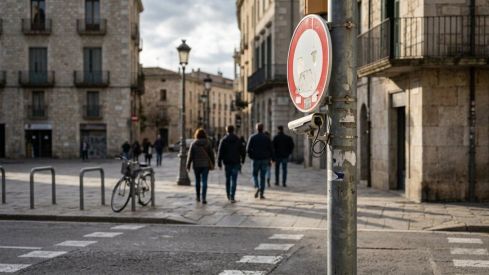
The Girona City Council has presented a consensus proposal to transform Plaça de Catalunya with a gradual traffic restriction and not with immediate pedestrianization. The plan comes after the participatory process opened in March and sets as its main measure a control camera on the east road, at the intersection with Carrer del Carme.
The main rectification compared to the 2024 pilot test is in the scope of the intervention. The council rules out closing a part of the square to vehicle traffic for now and opts to limit circulation only to authorized vehicles after complaints from residents and commercial activity registered on the west road.
The camera will limit passage on the east road to residents and authorized vehicles
The new regulation will allow access mainly to residents of the area and goods vehicles. People registered in Plaça Pompeu Fabra, Plaça de Catalunya, Avinguda de Sant Francesc, and Carrer del Carme from the Pont de l'Areny will also retain the right of way.
To this perimeter will be added the areas of influence of Pedreres-Fora Muralla and Torre Gironella, which the city council still needs to specify before activating the measure. Before launching the camera, it will also open a period for applications and inform those affected.
For unauthorized vehicles arriving from Avinguda de Jaume I, the route will change mandatorily and they will have to turn directly towards Passeig General Mendoza. The proposal also provides for the south road to become two-way to facilitate exit without having to go around the square.
The rearrangement incorporates changes in taxis, bicycles, and reserved parking spaces
The intervention is not limited to access control. The redesign of the space includes new parking spaces for bicycles and cargo bikes, the relocation of parking spaces for people with reduced mobility and motorcycles, and the transfer of the taxi rank from Avinguda Sant Francesc to the west road.
42 entities and associations from the area participated in the definition of the proposal, including residents, merchants, restaurateurs, and groups linked to mobility and accessibility. The municipal government now proposes a progressive implementation, conditioned by technical reports from the mobility and public space teams.
The change in criteria comes after the pilot test applied in 2024 on the west road, which generated neighborhood and commercial complaints and led the city council to postpone the immediate pedestrianization of a part of Plaça de Catalunya.