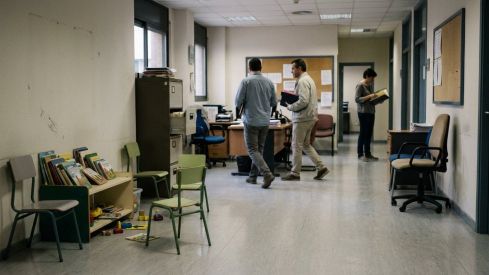
The Government and the autonomous communities have signed an agreement so that by 2030, 70% of children in the protection system are fostered by families, but public funding today maintains a very different direction. A study presented this Wednesday by the Childhood Platform places 82% of the funds allocated to residences, while only 9% is directed to family fostering and 4.4% to prevention.
The report, which analyzes contracts and subsidies from 2024 and 2025, calculates that there are at least 516.4 million euros committed in those two years to sustain the care system for supervised minors when their parents cannot take care of them or have lost custody. Currently, 51% of these children continue to live in residential homes.
A spending model far from the political objective
The research is titled "How does funding influence the child and adolescent protection system in Spain? The challenge of deinstitutionalization" and focuses on the gap between the signed political commitment and the actual destination of public money.
"Funding continues to be oriented in the opposite direction to the agreement signed between the Government and the communities" - Leire Olmeda, data expert from the deinstitutionalization area of the Plataforma d'Infància
The entity maintains that, if the objective is to reduce institutionalization and reinforce family foster care, the investment must accompany that change. The person responsible for deinstitutionalization at the Plataforma d"Infància, Sara Toledano, insists that the system maintains relevant differences between territories and also between resource management models, with direct effects on the quality of care and access possibilities.
"If the objective is to reinforce family reception and reduce the institutionalization of girls, boys, and adolescents, public investment must be coherently aligned with that political objective" - Sara Toledano, head of deinstitutionalization at the Plataforma d'Infància
Unaccompanied migrant minors and inequality in access
One of the points that the study considers most sensitive affects unaccompanied migrant minors. In these cases, 99.1% of the investment is allocated to residential resources, which, in the entity's opinion, shows that their care is channeled almost exclusively through centers and residences.
"The data show that, in practice, unaccompanied migrant childhood is cared for almost exclusively in residential resources" - Sara Toledano, head of deinstitutionalization of the Plataforma d'Infància
The report also warns that origin conditions access to other alternatives within the protection system. The Childhood Platform interprets this situation as a possible form of institutional discrimination that, in its opinion, must be corrected.
"This implies that, depending on their origin, girls, boys, and adolescents do not have equal access to other alternatives within the protection system, which points to a form of institutional discrimination that must be corrected" - Sara Toledano, head of deinstitutionalization at the Plataforma d'Infància
Urgent Hiring and Transparency Issues
The analysis also reviews how the provision of these services is being contracted. It detects a high use of urgent and emergency procedures, with a volume reaching 155.9 million euros. Added to this is that 57.3% of the contracts studied received a single offer, a figure that the entity considers problematic for free competition and for the quality of tenders in child and adolescent protection services.
The Platform for Childhood claims more stability in hiring and less recourse to exceptional formulas. It also asks to improve transparency in order to better evaluate public policies and their real impact.
"Improving transparency is key to ensuring effective accountability" - Pablo Martín, Chief Technology Officer of Political Watch
"When that happens, the capabilities for evaluating public policies and their impact on the lives of girls, boys, and adolescents are limited" - Pablo Martín, technology director at Political Watch
With these data on the table, the Childhood Platform proposes a progressive reorientation of the financing model, with more weight for family foster care and prevention policies, and less dependence on residential care if the horizon set for 2030 is to be met.