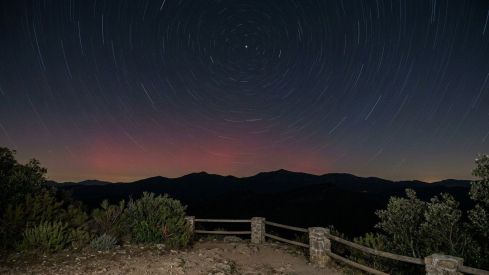
An aurora was recorded on the night of March 20-21 from Santa Bàrbara, between Sadernes and Oix, in Alta Garrotxa, in an image taken by Joel Buyé, amateur astrophotographer and resident of Vilademuls. The photograph captured in a single scene the reddish band over the northern horizon and the rotation of the stars in a particularly dark sky.
The shot was made in a single exposure of 8,195 seconds, that is, 2 hours and 15 minutes. Buyé started the photograph around midnight and the exposure lasted until two thirty in the morning, while he rested inside the car after two consecutive nights looking for clear skies.
A planned outing to photograph the zodiacal light
The initial plan was not to capture an aurora. Buyé had gone up to Santa Bàrbara with two companions to photograph the zodiacal light, a phenomenon that can be observed on especially clear nights. The outing also coincided with a new moon, a favorable condition for astrophotography because it reduces the clarity of the sky.
Before activating the long exposure, Torky Checa noticed a reddish hue on the northern horizon. Buyé also detected it in several test images taken with a very sensitive camera. Based on that indication, he decided to make a circumpolar, a long-exposure photograph designed to draw the trail of the stars around the pole.
The initial idea was to leave the camera working for an hour, but the time extended much longer than expected.
"I literally fell asleep" - Joel Buyé, amateur astrophotographer
The color appeared with clarity when reviewing the image
It was when reviewing the material that Buyé clearly confirmed the presence of the aurora. When editing the photograph and globally enhancing the red, the color appeared defined over the mountain line. The result brings together two elements in a single night, the circular movement of the stars over the sky of Alta Garrotxa and the reddish band of the aurora on the horizon.
The amateur had already photographed a similar episode two years ago, an experience that helped him identify that that tone did not correspond to a usual sky. That previous reference was key to correctly interpreting what he was seeing in the tests before leaving the camera working.
A demanding technique in environments without light pollution
Buyé explains that many star trail photographs are made today by joining multiple short images with editing programs, but he prefers to work with a single exposure. It is a more demanding technique and depends on very dark skies like those of Santa Bàrbara, since in areas with more artificial light the image would be overexposed.
Joel Buyé has been dedicated more seriously to astrophotography and astrolandscape for about six years. He also participates in the program Revelant l"Univers on Ràdio Banyoles alongside Torky Checa, Àngel Fajardo, and Noemí Leon. The image taken in Alta Garrotxa now leaves an unusual scene in Catalonia and documents a night in which the sky offered much more than the group had gone to look for.