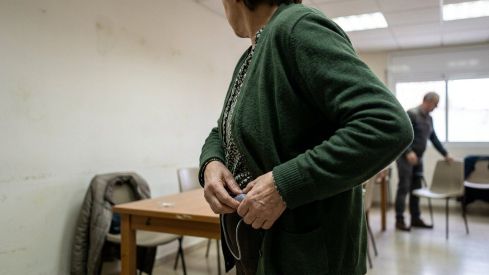
Victòria Saget, a 70-year-old neighbor diagnosed with Parkinson's since 2013, demands more resources and more institutional involvement in the face of a disease that continues to gain ground in Catalonia. The affected person denounces that a good part of the work carried out in recent years on this pathology has not translated into real improvements for patients and their families.
Parkinson's is today the second most frequent neurodegenerative disease, only behind Alzheimer's. In that context, Saget has decided to publicly make visible his situation and that of many other people who live with the disease daily.
"I have never hidden that I had Parkinson's" - Victòria Saget
A disease with daily impact
Saget explains that he needs a device that administers the medication directly into the prim intestine to regulate dopamine. It is a treatment that is part of his daily routine and that reflects the degree of complexity that the disease can reach over time.
It also warns that Parkinson's is not always perceived from the outside in its full dimension. "Sometimes what is seen is not the whole reality", he summarizes, in reference to limitations that in many cases are not evident at first glance, but that condition personal autonomy and daily life.
The creation of a specific association in Girona
Given the lack of entities specifically focused on this pathology in the regions of Girona, in 2022 the Associació Gironina del Parkinson was promoted. The entity has a presence in Girona and also in Alt and Baix Empordà, with the aim of offering support and building a support network for those affected.
For Saget, the role of the association has been decisive in his personal and collective process.
"The association has given me life, without this project I probably would have stayed at home, without motivation" - Victòria Saget
The creation of this space has allowed to channel demands, share experiences and give visibility to a reality that for years did not have its own structure in the Gerona territory.
Direct claim to the administration
Saget asks administrations and the healthcare system for more resources, more professionals, and more commitment. His criticism is directed especially at the lack of effective progress despite the debates and work developed in Catalonia on the approach to Parkinson's.
In this regard, it regrets that different participatory processes and working documents elaborated on this disease have ended up, in its words, stored in a drawer. The complaint points to a distance between the diagnosis of needs and the application of concrete measures.
His message, far from an exclusively personal vindication, puts the focus on those who will live with the disease in the future.
"Perhaps all these demands and improvements may not arrive in time for one's own benefit, but it is worth continuing for whoever comes after" - Victòria Saget
With that idea, Saget insists on maintaining the pressure so that Parkinson's stops occupying a secondary role in the public and health agenda, especially at a time when the number of affected and the need for specialized care continue to grow.