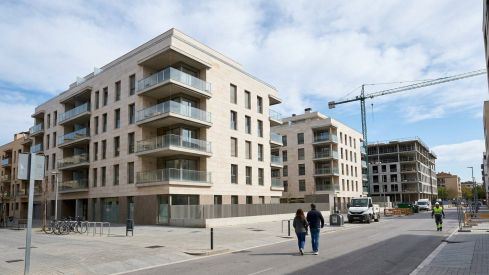
The construction of new housing in the regions of Girona accelerated between 2023 and 2025 and reached 7,333 approved homes, 54.3% more than in the 2020 and 2022 triennium, when 4,751 were counted. The rebound places the demarcation above the growth rate of Catalonia as a whole, where the increase was 19.3%.
The data consolidates a change of cycle in the territory. In the last three years, more than 2,000 new annual approved homes have been exceeded, a barrier that had not been surpassed since the bursting of the real estate bubble. 2025 closed as the best year of the last fifteen years in the demarcation, with 2,802 new approved homes.
From the collapse after the bubble to the sustained recovery
The series reflects the depth of the fall and the subsequent recovery. After the slowdown subsequent to the real estate bubble, the demarcation dropped below 500 new homes approved in 2013 and 2014. From there, activity began to reactivate until it once again exceeded 1,000 annual homes in 2017.
In 2018, 1,758 new homes were approved. In 2019 there were 1,424 and in 2020, 1,390. Afterwards, 1,702 arrived in 2021 and 1,659 in 2022. The definitive leap has been concentrated in the last three-year period, with a performance that even contrasts with that of Catalonia in 2025, when the country as a whole registered 7.5% fewer approved homes than in 2024, while Girona grew by 34.5%.
Baix Empordà leads the impulse and gains weight in the demarcation
The region that most pushed this advance was Baix Empordà. Between 2020 and 2022 it added 1,015 approved homes and between 2023 and 2025 it rose to 2,501, which represents an increase of 146%. By itself, it concentrated 34.1% of all new approved housing in the demarcation during the last three-year period. Its best year was 2023, with 918 homes, followed by 2024, with 896.
El Gironès, in contrast, registered the most moderate advance among the regions with the most volume. It went from 1,390 to 1,539 approved homes, 10.7% more. That more contained growth caused its weight on the total to drop from 29.3% to 21%.
Baix Empordà and Gironès jointly concentrated 55.1% of all new housing approved in the Girona regions between 2023 and 2025. Behind them, la Selva was positioned as the third region in volume after growing by 64.2% and going from 597 to 980 homes, ahead of l"Alt Empordà, which increased by 39% to 895.
Also rose Pla de l"Estany, with 49.1% more and 319 homes, Ripollès, with 24.1% more and 211, the Girona part of Cerdanya, with 20.2% more and 369, and Garrotxa, with 13.9% more and 442.
2025 leaves highs in several regions and contrasts in others
In 2025, the best figure of the last decade was recorded in four of the eight Girona regions. One of the clearest cases was La Selva, where 459 new homes were approved, well above the figures of between 200 and 260 of previous years.
The evolution was not homogeneous. In Cerdanya, 2025 left the worst figure since 2020, nearly 30% below 2022 and 2023. In Gironès, the best year remains 2018. In Ripollès, 2025 also fell below the three previous years.
Girona city leads the activity among the county capitals
Girona was the regional capital with the most new housing approved and maintained a clearly upward trend. It went from 168 homes in 2022 to 226 in 2023, 309 in 2024, and 367 in 2025. In the biennium 2024 and 2025, the city accumulated 71.8% more new approved homes than in 2022 and 2023.
Olot added 211 new housing units approved between 2024 and 2025, 42.6% more than in the previous biennium. Banyoles reached 155, with an increase of 21.1%. Figueres went from 8 housing units approved in 2022 and 2023 to 23 in 2024 and 88 in 2025. Puigcerdà grew from 40 to 97 housing units between bienniums, 142.5% more. Santa Coloma de Farners went from 34 to 70 and la Bisbal d"Empordà from 15 to 29.
Ripoll was the only county capital with a decrease. It registered 14 approved homes in 2022, 2 in 2023 and 5 both in 2024 and in 2025.
If one looks at the set of municipalities, those that accumulated the most new approved homes in the last two years were Girona, Calonge i Sant Antoni, Castell Platja d"Aro, Palamós and Vilablareix. Calonge i Sant Antoni registered 406 homes in 2024 and 2025, Castell Platja d"Aro 317, Palamós 232, Vilablareix 140 and Lloret de Mar 130.
More visaed surface area and slight rise in files
The total surface area approved in the Girona demarcation reached 768,298 square meters in 2025, 14.9% more than in 2024, when it was 668,730. The figure remained practically at the 2023 level, with 767,658 square meters, and was the second best of the decade after 2018, when it reached 866,247.
In the 2023-2025 triennium as a whole, the total approved surface area grew by 19.9% compared to 2020 and 2022. The number of files, however, increased much less, by 2%, going from 6,018 to 6,136. In 2025, 2,057 files were registered, below 2023, 2022, and 2021. The majority continued to be projects of less than 500 square meters, although their weight on the total surface area dropped from around 50% to around 40%.
The great rehabilitation rises in the three-year period, although it loosens in 2025
The approved surface area for major rehabilitation in the demarcation grew by 10% in 2023 and 2025 compared to the previous three-year period and reached 683,869 square meters, compared to the previous 622,249. New construction advanced more, with an increase of 27% in approved surface area. The volume of rehabilitation remained practically at the same level as between 2017 and 2019, when 683,815 square meters were reached.
In 2025, however, major rehabilitation dropped to 203,493 square meters, below 2024 and 2023. The best year of the decade in this section was 2023, at practically identical levels to 2018.
By counties, Cerdanya led the largest increase in major rehabilitation, with 95.2% more and 14,124 square meters. La Garrotxa grew 69.8% to 71,590. Baix Empordà led the total volume with 172,820 square meters, 25.3% of the total for the demarcation. Also exceeding 100,000 square meters were Selva, l"Alt Empordà and Gironès. In this last case, despite the volume, the area of major rehabilitation fell by 13.9% compared to the previous three-year period. In Ripollès the fall was 31.8%.
Protected housing remains a minority despite the rebound of 2025
Protected housing maintained a reduced weight in the Girona demarcation, although 2025 marked a visible change. During the last decade, in most years it had been below 15 annual units, with lows of 1 dwelling in 2017 and 2021, and 3 in 2018. In 2020, 44 were approved.
In 2025, 264 protected homes were approved in the demarcation, representing 9.42% of the total of 2,802 homes registered that year. The percentage was below the Catalan average, set at 14.34%. It was also lower than that of the demarcation of Barcelona, Comarques Centrals and Terres de l"Ebre, although it exceeded the records of the regions of Lleida and Camp de Tarragona.
Girona city concentrated 98 of those 264 protected homes. In the capital, they represented 26.7% of the total approved homes. Figueres added 51, equivalent to 58% of all homes in the city in 2025, and Banyoles registered 27, 24.8% of the local total. The general balance shows a promotional activity at highs of recent years in the regions of Girona, but also confirms that protected housing remains far from having a structural weight within the residential market of the demarcation.