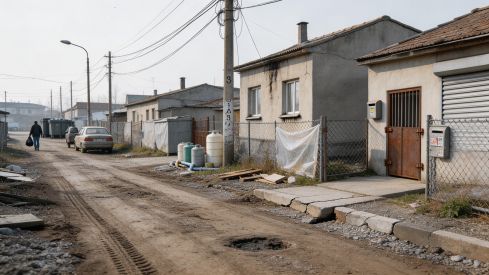
The Generalitat of Catalonia has approved a legal change that will allow city councils to regularize some 730 illegal urbanizations, a phenomenon widespread for decades and that affects thousands of residents who reside in areas outside of planning and, in many cases, without basic public services.
The measure is part of a reality that goes beyond Catalonia. There is no official state count of illegal dwellings, although an approximation developed from regional data and specialists in geography and urban planning places the figure at more than 665,500 dwellings throughout Spain.
A problem dragged from developmentalism
A good part of these urbanizations were built outside urban planning regulations, especially between the 60s and 80s, in the midst of full developmentalism. Their expansion was especially intense in the Spanish Levante. In numerous cases, these settlements came to have electricity and water, and their residents appear in the census and pay taxes, despite remaining outside urban legality.
The normative origin dates back to the land law of 1956, which set a generic urbanistic use for rustic land of 1 m3 m2. That framework allowed the implementation of residential and tourist buildings on non-urbanizable land. The 1975 law eliminated that possibility, although in many municipalities construction de facto continued upon meeting certain requirements or, simply, due to the lack of approved urbanistic plans.
Registered neighbors and without basic services network
One of the paradoxes of these urbanizations is that many residents pay municipal taxes, but continue without full access to basic infrastructure. In different areas, there is a lack of water supply, lighting, paving, or sewerage.
"We pay the IBI and the garbage fee, but we don't have services" - Pipe, resident of El Tallar
"The garbage trucks don't even enter. We only have two container areas outside the urbanization, and we pay for water and electricity from the association" - Pipe, resident of El Tallar
El Tallar, in Mejorada del Campo, is one of the three illegal urbanizations in that Madrid municipality. It totals 2,000 homes of different types and has been 45 years outside the law.
Andalusia and the Valencian Community concentrate a good part of the volume
In Andalusia, the Junta's calculations point to 500,000 buildings on non-developable land. Of that total, around 300,000 are irregular, mainly in the provinces of Malaga, Granada and Almeria. That figure comes from a regulation aimed at legalizing constructions that met certain requirements to be able to receive services under minimum conditions of safety and health.
In the Valencian Community, 193,919 illegal homes built on undeveloped land are counted. In 2014, the Valencian Government approved a law that introduced mechanisms for their legalization through the minimization of territorial impact. Of the total irregular properties, 27% are located on protected undeveloped land.
Madrid exceeds 10,500 illegal constructions
In the Community of Madrid there are more than 10,500 illegal constructions distributed in nearly 184 illegal origin urbanizations. The case of El Tallar reflects a shared situation in different parts of the country, where thousands of owners and residents remain awaiting urban planning solutions that allow entire neighborhoods built outside of planning to fit in.
With the change approved by the Generalitat, Catalonia now opens a way for city councils to be able to act on that urban legacy and address the regularization of hundreds of urbanizations that, despite existing for decades, continue in an administrative limbo.