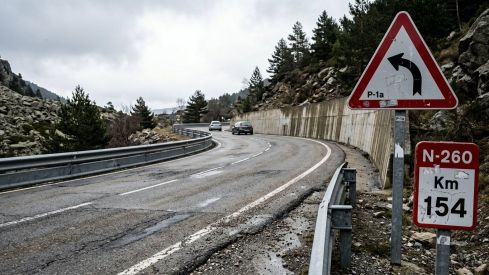
The province of Girona concentrates 13 black spots on the State Road Network and all are on the N 260, according to a report by European Motorists Association prepared with data from the Ministry of Transport and Sustainable Mobility. In those 13 stretches, 66 accidents with victims and 86 victims were registered between 2020 and 2024.
The study places the main focus on several points of the Girona demarcation, with special emphasis on the Toses pass, within the municipality of Alp. There are located some of the highest danger indices in all of Spain despite an average daily intensity of 275 vehicles.
The Toses pass concentrates the highest indexes
The Girona section with the highest Medium Hazard Index is at the kilometer point 165 of the N 260, in Alp, in the middle of the Toses pass. That segment ranks fourth in the state ranking with an IPM of 852.4.
Also in Alp, kilometer point 161 appears in eighth place in the state classification with an IPM of 639.3. In 24th place is kilometer 67, in Sales de Llierca, with an IPM of 312.9. In total, six sections of Girona are among the top 50 in Spain by dangerousness.
In Cerdanya, the highest concentration is located precisely in the vicinity of the Toses pass, where the report includes kilometers 156, 161, 165 and 167, all in Alp.
Vilanant heads the stretches with most accidents
If one considers the volume of accidents and victims, the most affected stretch in Girona is that of kilometer point 45, in Vilanant. That sector accumulated 20 accidents with victims and 30 victims, which makes it the point with the highest accident rate in the province within the report.
Kilometer marker 85, in Vall de Bianya, registered 14 accidents and 15 victims. Kilometer 18, in Llançà, recorded 11 accidents and 15 victims.
By regions, in Alt Empordà appear kilometers 18 of Llançà and 45 of Vilanant. In Garrotxa, kilometers 67 of Sales de Llierca and 85 of la Vall de Bianya. In Ripollès, the report incorporates the sections of kilometers 132 and 133 in Ribes de Freser, 139 and 175 in Planoles and 141 in Toses.
Girona gathers about 29% of the Catalan black spots
In Catalonia, the report locates 45 particularly problematic stretches, with 562 accidents with victims and 752 victims. Girona concentrates about 29% of those black spots, in addition to around 11.7% of accidents with victims and 11.4% of the victims.
To identify the most problematic segments, the study selects one-kilometer stretches with an Average Hazard Index equal to or greater than 82. That threshold is equivalent to a hazard at least ten times higher than the state average, located at 8.2.
In Spain as a whole, 295 especially dangerous kilometers have been located, spread over 67 roads in 45 provinces, where 1,752 accidents and 2,497 victims were registered.
The N 260 already appeared in previous risk maps
The situation of the state network in the Girona regions had already been reflected in the 22nd edition of the Risk Map of the State Road Network, corresponding to the 2022-2024 triennium. That study placed four of the ten most dangerous sections of the state network in Catalonia within Girona.
Three of those four sections were on the N 260, between Puigcerdà and Ger with 7.71 kilometers, between Isòvol and Ger with 8.82 kilometers and between Navata and Besalú with 14.48 kilometers. The fourth was on the N II, between Capmany and La Jonquera, with 5.73 kilometers.
That risk map was developed with iRAP methodology and, like the current report, analyzed only the state-owned network. Therefore, roads under the jurisdiction of the Generalitat, such as the Eix Transversal or the regional roads, were left out.