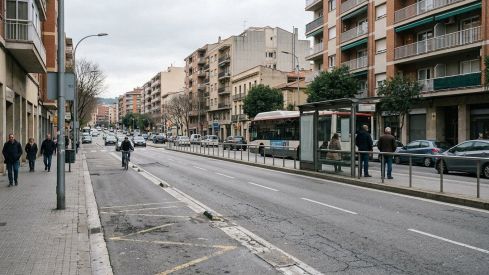
Girona is studying a reorganization of the Barcelona road and Riu Güell to reduce the weight of private vehicles and give more space to pedestrians, bicycles, and public transport. The document, delivered in December 2024, proposes low-cost actions based on signage, paint, and urban furniture, without major civil works.
The work, titled Propostes d"ordenació viària dels eixos del carrer Barcelona i Riu Güell, was commissioned by the Girona City Council and awarded to the company Gea21 Grups d"Estudis i Alternatives. The proposal starts from the inverted pyramid of sustainable mobility, which places pedestrian travel first, then cycling and public transport, and leaves private motorized vehicles at a lower level.
A progressive funnel on the Barcelona road
On Barcelona road, the study detects pedestrian and cyclist mobility deficits. It points out sections of sidewalk that are too narrow or deficient, especially between Salvador Dalí square and Pau Vila street, and also a lack of trees in a good part of the axis, especially in its northern half. By bicycle, it notes that the network is interrupted from Salvador Dalí square.
The central idea is to apply a south-to-north funnel, with a progressive reduction of space for private traffic as the road approaches the center. The report proposes continuous cycling infrastructure along the entire Barcelona road, without diverting the route through parallel streets.
In the section between Mas Gri and the future Ermessenda Institute, the current 2+2 section would be maintained, although with the start of the transformation of the sides into sidewalks, especially in front of Clínica Girona. Between the future Ermessenda Institute and Salvador Dalí square, it is proposed to eliminate a lane in the northbound direction to create a bus lane and complete the bike lane.
From Salvador Dalí square to the d'Olot promenade, the proposal involves reducing private traffic to 1+1, widening the west sidewalk, which now fails to meet accessibility criteria, and creating a bidirectional bike lane on the roadway.
In the central section, between the d'Olot promenade and La Devesa, the document opens several scenarios. They range from traffic light penalties to an almost total restriction of private traffic to reserve space for buses, taxis, loading and unloading, services, bicycles, and pedestrians. The most restrictive options imply that this sector stops functioning as a fast corridor to cross Girona by car.
The study proposes that this traffic be diverted towards the primary and secondary network or towards the AP 7. It also warns that the transformation of the Barcelona road should be accompanied by a reconfiguration of the surrounding streets to avoid shortcuts and through traffic through the neighborhoods.
Bus segregated at specific points and two short-term options
In public transport, the report does not see it necessary to implement a bus lane along the entire axis of the Barcelona road. It does propose segregating the bus in some sections of the northbound direction, where congestion is concentrated. That space reservation would also serve for the bus of the users of the Mas Gri park-and-ride facility.
In the short term, the document outlines two alternatives to start the transformation. The first involves prohibiting circulation in the northbound direction, towards La Devesa, on the Ferran Puig ring road, converting the freed lane into a bidirectional bike lane and changing the direction of circulation of Álvarez de Castro to better reorganize the flows and also the route of several bus lines.
The second alternative adds an exclusive space for pedestrians on the west roadway of Marquès de Camps square. That action would enlarge the square and would help to break the continuity of private traffic in the central section of the axis.
The point with the most pollution in the city
The intersection of Ferran Puig ring road with Marquès de Camps square is considered by the City Council as the point with the most pollution in Girona. The average recorded there in 2024 was 40 μg m3 of nitrogen dioxide, compared to the 25.6 μg m3 average of the city's network of meters. That value of 40 μg m3 coincides with the acceptable limit for health set by international organizations.
Riu Güell, fewer shortcomings and a pending bike lane
In Riu Güell, the study appreciates fewer problems for pedestrians because the sidewalks are accessible or practicable. The main deficit appears in the bicycle, with the lack of a section of bike lane between Poble Sahrauí street and Santa Eugènia street, at the height of the Maristes school.
The report also detects that the bike lanes of the Fontajau bridge have little width and that users perceive insecurity due to the proximity and speed of motorized vehicles. In contrast, no serious problems are detected today by bus. It is only pointed out that, if in the future a new urban line is implemented through Riu Güell, a bus lane in the southbound direction could be useful before the Santa Eugènia roundabout.
The immediate proposal in this axis is to complete the pending section of bike lane between Poble Sahrauí and Santa Eugènia by eliminating a traffic lane. It is also proposed to widen the bike lanes of the Fontajau bridge by reducing the width of the lanes for cars.
In the longer term, the study proposes reducing the Riu Güell section to 1+1 between the d"Olot promenade and Santa Eugènia street to improve acoustic quality, widen sidewalks, and move the trees away from the facades.
A commission that was delayed more than a year
The idea of commissioning this study was born in the previous municipal term. The first attempt to contract it was made in the summer of 2023, but the tender remained deserted. In a second call, nine companies presented themselves, although the procedure was stopped due to a technical error. The award did not arrive until the third tender, already in 2024, with a starting price of 9,857.07 euros.
The report now remains on the City Council's table as a basis for deciding whether to initiate gradual changes in two of the city's most sensitive road axes, with the Barcelona road as the main front of action due to its role in daily mobility and the traffic pressure it endures at the entrance to the center.