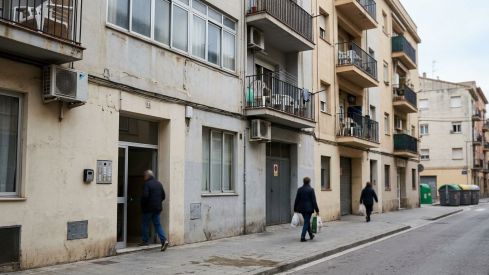
The residents of the Girona regions allocate on average 32.8% of their income to housing, in a context marked by the rising cost of essential goods and by strong tourist pressure in part of the territory. The data appears in the social report of the Department of Social Rights, which places particularly high tourist pressure in Alt Empordà and Baix Empordà with a direct impact on the residential market.
The document argues that the concentration of tourist accommodation is behind part of the price increase, especially in the most strained areas. The Girona regions gather 252,356 tourist housing units, more than 43% of the total in Catalonia, a proportion that the Government links to the rising cost of housing access.
"I recognize that tourism is one of the factors that make the cost of housing more expensive" - Mònica Martínez Bravo, Councillor for Social Rights
Salt, Lloret de Mar and Figueres among the most strained areas
The report identifies Salt, Lloret de Mar, and Figueres as particularly strained areas. In these municipalities, households allocate more than 110% of their income to cover basic expenses, mostly related to housing. This pressure is noticeable throughout the demarcation, where spending on housing and food absorbs almost half of family incomes.
The average rent in the regions of Girona stands at 677 euros, although the report warns that in Alt Empordà and Baix Empordà the price can be higher precisely due to the weight of tourism. Added to this is a monthly cost of living of 3,266 euros, slightly below the 3,378 euros average in Catalonia, but with territories where the economic effort is especially high, such as Cerdanya, Pla de l"Estany and Gironès.
The increase in essential goods squeezes families
The document points to the increase in the price of essential goods as the main pressure factor on household economies. Economic growth, it adds, is not having a uniform effect on the population and aggravates internal differences between municipalities and neighborhoods.
In the city of Girona, that inequality is reflected in differences of up to 76 points in the Territorial Socioeconomic Index between neighborhoods. The report describes this situation as a strong socioeconomic polarization within the Gerundense capital.
A labor market with contrasts
The demarcation presents an employment rate of 56.3% and an unemployment rate of 8.4%. The report thus places it among the provinces with one of the lowest employment levels and one of the highest unemployment levels in Catalonia, despite the weight of its economic activity.
The services sector exceeds 70% of the GDP of the demarcation and industry is around 20%. La Garrotxa stands out as an exception due to an industrial base that represents more than 40% of its regional GDP. In parallel, Girona is the Catalan province with the fewest differences in GDP per inhabitant between regions, with 75% of them in intermediate values within the Catalan distribution.
Even so, most of the Girona counties remain below the Catalan average in GDP per inhabitant. The values range from 33,972 euros in La Garrotxa to 27,096 euros in El Ripollès. El Gironès concentrates the largest volume of economic activity, with 7,854 million, and also registers the highest GDP per inhabitant, with 38,581 euros, being the only county in Girona that exceeds the Catalan average.
"The Govern's 50,000 plan must serve to build social housing and expand the current stock" - Mònica Martínez Bravo, Minister of Social Rights
The photograph that the report leaves is that of a demarcation with relevant economic activity, but with a growing pressure on households due to the price of housing and basic expenses. In the regions most exposed to tourism and in municipalities like Salt, Lloret de Mar or Figueres, that tension translates into an economic effort that overflows the capacity of many families.