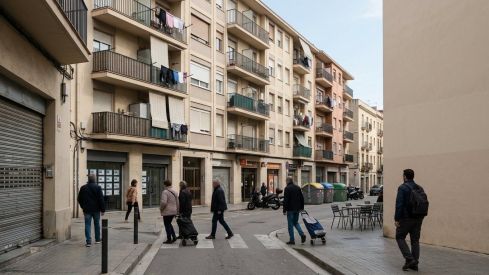
The cost of living and the difficulties of access to housing have consolidated as the main social challenges in the regions of Girona. Thus it is collected by the Social Report of Catalonia 2025, presented this Wednesday in the Gerundense capital by the Minister of Social Rights and Inclusion, Mònica Martínez Bravo, in a diagnosis that places economic pressure on households as one of the central focuses of the demarcation.
The average cost of living in Girona stands at 3,266 euros per month, a figure that the report links to a very strained spending structure, especially due to housing. In municipalities such as Salt, Lloret de Mar and Figueres, some households allocate more than 110% of their income to cover basic expenses, which evidences situations of strong vulnerability.
Housing concentrates the greatest pressure on households
Housing appears as the main factor of economic pressure in the demarcation and represents 32.8% of family spending. Next is food, with a weight of 16%. The report also sets the average rental price in Girona at 677 euros per month, in a context of special residential tension.
That pressure is not distributed homogeneously. La Cerdanya, Pla de l"Estany, and Gironès are among the territories where the cost of living is especially high. To this is added the weight of tourist-use housing, since Girona concentrates 43.4% of the places of this type of accommodation in Catalonia, with a particularly marked presence in Baix Empordà and Alt Empordà.
Internal inequality and limited social coverage
The study detects a strong socioeconomic polarization in the city of Girona. Among neighborhoods, differences of up to 76 points are registered in the Territorial Socioeconomic Index, an indicator that reflects the internal distance between areas of the same city.
In parallel, the report points to insufficient coverage of the Renda Garantida de Ciutadania in several regions, with 14 recipients per 10,000 inhabitants. Despite this, the benefits system manages to reduce inequality by 30.9%, especially thanks to the effect of pensions.
"detect and prioritize social needs" - Mònica Martínez Bravo, councillor of Social Rights and Inclusion
During the presentation, the minister warned that income inequality continues to be one of the country's great challenges and defended the need to promote policies rooted in the territory to strengthen social cohesion.
An economy very linked to services and tourism
The economy of Girona maintains a clear dependence on the services sector, which exceeds 70% of the GDP of the demarcation. Industry retains an approximate weight of 20%, with La Garrotxa as a reference for its industrial base. El Gironès leads economic activity and reaches a GDP per inhabitant of 38,581 euros, the only one in the demarcation above the Catalan average.
In the labor market, Girona registers an employment rate of 56.3%, one of the lowest in Catalonia, while the unemployment rate stands at 8.4%. The report attributes part of this situation to the dependence on tourism, with effects of seasonality and precariousness on employment.
Demographic weight of the foreign population
The foreign population represents 21.9% of the total of the demarcation and in l"Alt Empordà it reaches 25%. The report highlights that this group is essential to curb demographic aging and sustain both the labor market and the welfare system.
The report draws a demarcation with relevant economic activity, but also with strong social and territorial imbalances. The combination of expensive housing, employment conditioned by seasonality, and internal inequalities places the Girona regions before a scenario that obliges to reinforce social policies with a proximity perspective.