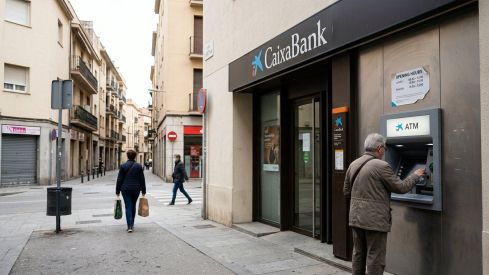
Girona is the Catalan province with the highest banking concentration in the office network, according to the latest study by the Catalan Competition Authority. The report also places this territory among those that show more tension in the credit market and warns of a high risk of financial exclusion in a large part of the demarcation.
The analysis concludes that the concentration of the banking sector in Catalonia has intensified since the 2008 financial crisis. The reduction of entities, the closure of branches, the disappearance of ATMs, the loss of employment, the disappearance of the old savings banks and merger and acquisition operations explain this process, which was particularly accentuated after the integration of Bankia into CaixaBank.
CaixaBank exceeds half of the office network in Girona
In the province of Girona, CaixaBank concentrates 50.63% of the branch network. Banc Sabadell occupies the second position with 16.03% and BBVA the third with 13.50%. Among the top three entities, they control 80.17% of the branches, while the top five reach 93.25%.
The Herfindahl Hirschman index, used to measure concentration, stands at 3,134 points in Girona's office network. It is the highest value in Catalonia and is above Barcelona, with 2,103 points, Lleida, with 2,712, and Tarragona, with 2,851.
Also there is strong concentration in the credit
The pressure is not limited to the branches. In total credit, CaixaBank leads in Girona with a share of 42.69%, followed by BBVA with 17.38%, Banc Sabadell with 15.69% and Santander with 12.22%. The first three entities gather 75.76% of the market and the first five concentrate 92.37%.
The HHI of total credit in Girona reaches 2,557 points. In credit to households, CaixaBank reaches 44.66%, with a concentration index of 2,701 points and with the five main entities controlling 93.17% of the market. In credit to SMEs, CaixaBank reaches a share of 41.50%, the five most relevant entities concentrate 93.86% and the HHI stands at 2,495 points.
"These levels can translate into more difficulties to access financing, less negotiation capacity of clients and less favorable conditions, especially for individuals and small businesses" - Catalan Competition Authority
The body also considers that digital competition does not sufficiently compensate for this concentration. The pressure from online banking, fintechs, and new operators continues to be limited, especially in products of greater complexity or relevance such as mortgages or credit to SMEs.
More than half of the municipalities do not have an office nor an ATM
Girona has 122 municipalities without an office or ATM. That figure represents 55.20% of the provincial total. The lack of stable access to banking services affects 7.87% of the population, a percentage that only Lleida surpasses in the Catalan whole.
The province registers 24.92 km² per office and 7.25 km² per ATM. The ratio of inhabitants per office stands at 3,464.59. For the ACCO, the risk of financial exclusion is especially high in Girona and Lleida, and quite a bit lower in Barcelona.
The study warns that a highly concentrated structure can result in higher service prices, poorer service, reduced hours, higher commissions, lower remuneration for deposits, more obstacles to access credit, and less product variety. It also warns that, with few operators and scarce real alternatives, users' negotiation capacity is reduced and the risk of parallel behaviors or tacit coordination among entities increases.
Marked differences between municipalities
The concentration also presents differences within the demarcation itself. In the city of Girona, the IHH is 1,478. In contrast, Castelló d"Empúries reaches 3,600 points. Castell Platja d"Aro and Lloret de Mar are at 3,333, Banyoles and Torroella de Montgrí at 2,778, Palafrugell at 2,222 and Blanes at 2,099. Figueres, with 14 offices, registers an IHH of 1,939.
Measures to curb financial exclusion
Among its main conclusions, ACCO asks to avoid new operations that further increase concentration, especially in municipalities or areas with little banking presence. It also demands that competition authorities take into account the Catalan reality and, specifically, that of territories like Girona when evaluating future mergers or acquisitions.
The body proposes reinforcing measures against financial exclusion with mobile offices, itinerant financial agents, and displaced ATMs. It also recommends promoting shared ATM networks and independent ATMs under non-discriminatory conditions, in addition to open agreements between banks and operators with infrastructure already established in the territory, such as Post Offices, tobacconists, lottery administrations, supermarkets or gas stations, to expand access to cash and basic services.
The study positively values the itinerant mobile banking service promoted by the Generalitat, which currently serves 457 municipalities without a permanent bank office. More than 100 of those municipalities are in the Girona regions. Even so, the ACCO emphasizes that these alternative mechanisms continue to have low usage and demands more information, financial education, and measures to facilitate access to the digital channel, especially among the elderly and the most vulnerable groups.