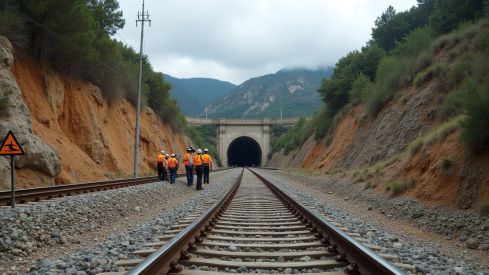
Train circulation on several Rodalies de Catalunya lines remains suspended after the detection of 23 critical points on the railway infrastructure that drivers consider incompatible with service safety. The decision particularly affects the R3 routes between Vic and Puigcerdà and the R15 in the Ebre region, where travel is being carried out by road.
Negotiations following fatal accident in Gelida
Last Wednesday, the SEMAF union refused to operate trains after a fatal accident in Gelida involving an intern. The drivers cited a lack of safety on several sections of the network. This protest triggered negotiations between SEMAF, Renfe, Adif, and the Catalan government to address infrastructure conditionsRenfe, Adif, and the Catalan government publicly defended the reliability of the railway tracks, although they later offered train drivers the chance to participate in a joint review of the 23 points identified as critical
Landslides and service suspension
The Catalan government requested Renfe to suspend the service on Saturday after new landslides were registered near the tracks. The Minister of the Presidency, Albert Dalmau, emphasized the priority of railway safety.
"As service holders, we request its suspension until the railway operators, Adif and Renfe, can guarantee safety" - Albert Dalmau, Government
Among the most affected areas are the Garraf tunnel on the R2 south and Badalona on the R1. The slope damaged by the storm in Badalona has already been repaired, but concern persists in other areas
Areas Under Surveillance and New Incidents
On the R3, between Vic and Puigcerdà, five risk areas have been detected due to landslides on the slopes. The R15 also concentrates several critical points in the Ebre regions. Furthermore, dangerous zones have been identified on the R4, R13, and R11, especially near PortbouIn the last few hours, minor incidents have been recorded in other locations that do not yet appear on the official map of critical points. The problems detected include potholes and trees that, in episodes of wind, can interrupt train circulation
Institutional Commitment and Underlying Causes
The Government and Adif have reiterated their commitment to evaluating all critical areas and seeking definitive solutions to guarantee the safety and resilience of the railway network. The critical points are especially vulnerable to adverse weather conditions.
Sources familiar with the negotiation indicate that the incidents are not solely due to recent storms. The accumulation of years of disinvestment and lack of maintenance are also among the causes pointed out by those involved.