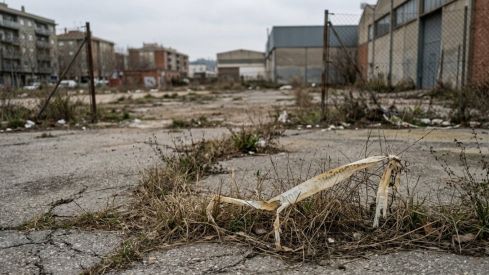
The new building of the Arxiu Històric de Girona in Fontajau still has no construction date 15 years after its presentation and the plot reserved for its construction currently functions as a car park. Until June 14, it also serves as a logistical space for a television shoot.
The stalemate contrasts with the lack of space at the current archive headquarters, in the old convent of Sant Josep, in the Barri Vell, where the Generalitat de Catalunya has managed it since 1982 in a state-owned building that cannot assume large fund revenues with full guarantees.
Disagreement over an alleyway is holding up the transfer of Fontajau
The origin of the project dates back to 2009, when the Girona City Council and the Spanish government agreed on a land swap. That agreement was transformed into a public domain transfer in 2022, but the process became stalled due to institutional disagreements over the ownership of an alleyway near the Ruyra house.
Quim Ayats, second deputy mayor of Girona, summarized the point of friction by stating that "they say it must be determined whether it is public or not." From the sub-delegation, Pere Parramon replied with another direct accusation and assured that "the City Council is not ceding the Fontajau plot."
Marc Lamuà, PSC deputy in Congress, also held the city council responsible for the slowdown. Lamuà argued that every time the processing seemed to be advancing, the City Council "has been responsible for hindering and torpedoing the process," adding that the Ministry of Culture maintains the budgeted investment for years.
Faced with this exchange of reproaches, the former director of the Arxiu Històric de Girona between 1988 and 2003, Josep Matas, downplayed the urban planning conflict. Matas recalled that delimitation difficulties are "very, very frequent in the Barri Vell" and added that the matter "is not justified" as an obstacle.
The 32,000 notarial volumes remain in the Barri Vell awaiting transfer
While the legal formula remains unresolved, the notarial funds from four districts continue to await transfer. This documentation is from Figueres, Girona, la Bisbal d'Empordà, and Santa Coloma de Farners, corresponding to the period 1261-1919 and consisting of 32,000 volumes.
In March, a monitoring commission was established with the City Council, the Ministry of Culture, and the Generalitat de Catalunya. The first meeting took place on the sixth and the next is scheduled for June.
Enric Cobo, deputy director general of Archives and Document Management of the Generalitat, calculates that the project may now increase its cost to 18 million euros. His forecast involves closing the legal formula this year to have funds to start the works in 2027 and 2028.
Cobo attributes the delays to the economic crisis, the real estate bubble, the lack of understanding between administrations, and the pandemic. In this context, the Generalitat has transferred documentation to La Bisbal d'Empordà and is looking for a rental space in Gironès to alleviate the lack of space.
The situation also affects the Municipal Archive. Lluís-Esteve Casellas, director of the service, warned that next year it will enter a critical phase due to storage capacity and demanded that any eventual move to the Sant Josep convent comply with European energy efficiency regulations because, he said, "We will not enter a second-rate archive."
The project foresees 31,754 linear meters and a room for 81 people
The winning proposal from BOPF Arquitectes reserves 31,754 linear meters of shelving in a three-story building. The design includes 120 flat spaces for special storage and dedicates 54% of the usable area to storage, out of a total of 6,489.40 square meters built.
The program also incorporates a multipurpose room on the ground floor with a capacity for 81 people. If the Municipal Archive were to move to the Sant Josep convent, that move would allow storage capacity to be doubled to over 5.5 linear kilometers with the integration of the Institut Vell, the CRDI, and the Administrative Archive.
So far, the State has allocated 1,757,781.34 euros to the current headquarters of the Girona Historical Archive for the rehabilitation of the facade, the renovation of carpentry, and the improvement of fire suppression systems.