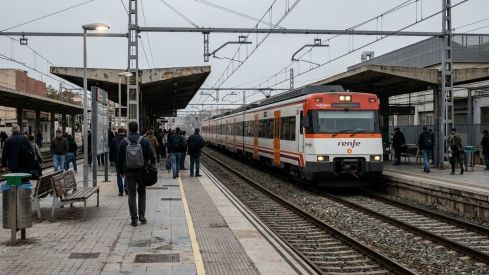
The Rodalies and regional journeys between Barcelona and the 24 county capitals connected by the network are today longer than 25 years ago. That is the main conclusion of an analysis prepared based on the official timetables from May 2000 and November 2025, taking as reference the shortest times in the Barcelona direction and excluding the first and last trains of the day.
The comparison is based on the schedules disseminated in both periods and not necessarily on the real times of passage or arrival. Even so, the photograph is clear. In all the county capitals analyzed, the minimum journey to Barcelona now lasts longer than in 2000.
Girona, Figueres and the R3 also worsen
Between Barcelona Sants and Girona, the regional now takes 1 hour and 21 minutes, seven minutes more than in 2000, in addition to adding a stop. Between Figueres and Barcelona, on lines R11 and RG1, the fastest services take 1 hour and 54 minutes, nine minutes more than 25 years ago.
The loss of speed is also noticeable on the R3. The journey between Vic and Barcelona Sants took 71 minutes in 2000 with a stop at eight stations. In 2024, the best time was 86 minutes with eleven stops. From Puigcerdà and Ripoll to Barcelona, journeys now take around 20 minutes more than then, also with more stops en route.
More time in the south of Catalonia
In the Terres de l Ebre and Camp de Tarragona, the trend is also repeated. In November 2025, the journey between l"Aldea Amposta and Barcelona Sants was 2 hours and 14 minutes, compared to 1 hour and 59 minutes in May 2000. From Tortosa to the Catalan capital, the journey has gone from 2 hours and 10 minutes to 2 hours and 26 minutes.
Between Tarragona and Barcelona, the services of lines R14, R15, R16 or R17 have gone from 65 to 71 minutes. In the case of Reus, the R14 now takes 1 hour and 31 minutes, ten minutes more than in 2000.
The R4 concentrates some of the biggest increases
The R4 appears as the line with the biggest differences compared to a quarter of a century ago, especially in the Penedès and Baix Llobregat section. Between Martorell and Barcelona Sants, the minimum journey has gone from 28 minutes in 2000 to 39 minutes before the Gelida accident. It is 39% more and with two added stops.
Between Vilafranca del Penedès and Barcelona Sants, the best time has increased from 53 to 70 minutes. From El Vendrell station to Barcelona, the minimum has gone from 69 to 90 minutes.
There are also increases in other metropolitan corridors. From Terrassa Estació del Nord, Sabadell Centre and Mataró to Barcelona Sants, increases of up to five minutes are registered. From Manresa, it now takes eight minutes longer and there are nine more stops than in 2000. From Granollers Centre to Barcelona, there are two more minutes on both the R11 and the R2. From Sant Feliu de Llobregat, there are two more minutes on the R1 and the R4. From Vilanova i la Geltrú, one more minute on the R2 Sud. And from Sant Vicenç de Calders, in El Vendrell, five more minutes.
The exception is the connection with El Prat airport, which maintains the same travel time as 25 years ago. The journey continues to be 20 minutes.
Lleida and the interior aggravate the loss of time
On lines R13 and R14, the journey between Lleida and Barcelona Sants was made in 2 hours and 8 minutes in 2000 with eleven stops. In November 2025 it took 20 minutes more and added six more stops.
Les Borges Blanques is the county capital with the biggest worsening detected, with 29 more minutes of travel time. Valls and Montblanc register increases of between 15% and 25% on these same lines.
More frequency and less available capacity
"There is an increase in trains that stop at all stations and in frequencies, but what has not increased is the capacity of the network" - Adrià Ramírez, president of the PTP
Ramírez maintains that the increase in services with more stops has penalized fast or semi-direct trains, which must share more space on the network or have disappeared directly.
"They are forced to share more space and, therefore, take longer, or have directly disappeared" - Adrià Ramírez, president of the PTP
Strained infrastructure and works that lengthen journeys
Joan Carles Salmerón, director of the Centre for Transport Studies, attributes this evolution to a lack of investment that has ended up causing a "weakness of the railway system". In his opinion, the works started in recent years have also contributed to lengthening journeys.
"Three or four years ago, when money finally started to be invested, works began that also increased travel times" - Joan Carles Salmerón, director of the Centre d"Estudis del Transport
On the R4, Ramírez links part of the worsening in Penedès and Baix Llobregat to the undergrounding works in Sant Feliu de Llobregat. He points out that there is a single-track section and considers that these works do not improve the lives of users across Catalonia. He also relates the disruptions to the works of the Mediterranean corridor, understanding that passengers and goods continue to share infrastructure.
Salmerón defines the R4 as a key piece of the Mediterranean corridor and warns that its duplication should already be being planned. In his opinion, it is one of the most saturated points of the entire Catalan railway network and requires immediate actions.
Demand for planning and new infrastructures
Among the measures proposed to cut times, Ramírez advocates for more maintenance and more capacity. He proposes quadrupling tracks in sections like Castelldefels and El Prat, an action that would be delayed beyond 2030, and tripling the track between Montcada i Reixac and Mollet del Vallès. Furthermore, he assures that the Ministry of Transport has 11 studies stalled and beyond the committed deadlines.
Salmerón adds that the Generalitat is developing a services plan, an instrument that he considers absent for decades. Its approach involves first defining how the population will move in the territory and then executing the necessary works. He also warns that demographic growth could lead Catalonia to 10 million inhabitants, which will force the creation of new lines and new stations. He also recalls that the last infrastructure plan that was fulfilled dates back to the 60s and 70s and was executed in the 80s, when Catalonia had 6 million inhabitants, compared to the current 8 million.