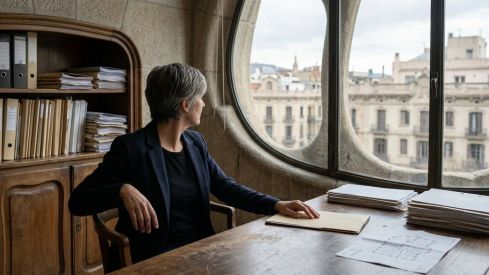
Marta Lacambra exercises her leadership from the office of La Pedrera in Barcelona. Born in Tangier in 1957, she directs the Catalunya La Pedrera Foundation with a clear vision on the role of heritage.
We have turned Gaudí's heritage into a tool for social return, states the executive, explaining the essence of the entity established as a private organization in 2013.
The economic engine of the modernist building
The foundation is the heir to the old social work of Caixa Cataluña and reinvests the income from its spaces in social and cultural projects. Tourist management is vital to sustain this non-profit structure.
"It would be very unintelligent not to take care of the goose that lays the golden eggs" - Marta Lacambra, director of the Catalonia La Pedrera Foundation
Approximately one million people visit La Pedrera each year, although the maximum capacity is around one million two hundred thousand annual visitors. The tourist profile is overwhelmingly foreign.
90% of the building's visitors are international. This reality forces us to have audio guides in fourteen languages to serve such a diverse audience.
Urban tensions and administrative regulation
Barcelona surpasses 26 million annual visitors, a figure that generates intense debates about coexistence and the use of public space. Tourist pressure directly affects life in the neighborhoods.
Lacambra delineates the responsibility of asset management from general urban planning. He considers that macroscopic decisions correspond to public authorities.
"Tourism policies, regulation or planning correspond to the administrations" - Marta Lacambra, director of the Catalunya La Pedrera Foundation
His future aspiration is that the model be understood in its entirety. The foundation seeks to complement public missions in critical areas such as education or health.
Territorial Impact Beyond Barcelona
The managed facilities include Món Sant Benet and various natural spaces such as the Congost de Mont-rebei. Social action extends throughout the Catalan territory through concrete initiatives.
The Oms y de Prat School in Manresa represents one of the educational projects developed by the entity. They also participate in food research through the Alícia Foundation.
The Alzheimer's program aims to reach 5,000 participants according to the current strategic plan. In addition, the MANS employment inclusion initiative is part of its social projects.
Work is underway on the transformation of Planes de Son into an eco-lodge to boost the Pyrenees. This expansion seeks to balance the concentration of resources in the capital.
Lacambra suggests as a structural desire that value be better distributed throughout the territory. He mentions that the Sagrada Familia also allocates part of its income to similar social purposes.
The relationship with the local public is strengthened through high-level exhibition programming. The latest exhibition Les Nabis brings together works that are difficult to see in other Barcelona galleries.
The institution collaborates in a network with the Liceu and the Palau de la Música. These alliances strengthen the cultural fabric against the tensions that mass tourism causes in the Catalan capital.