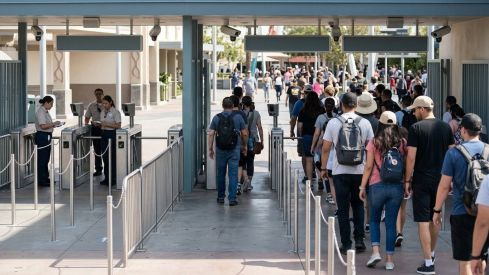
Disneyland and Disney California Adventure are using facial recognition access that converts visitors' faces into biometric data to verify entries and annual passes. The system scans the face and translates that information into "unique numerical values," which are then compared with the photographs linked to the tickets or passes.
The model is not mandatory, at least not formally. Visitors who do not wish to undergo scanning can use alternative, signposted entrances. Even so, these options are a minority within the set of available queues. Last Friday, among several dozen entrances to the parks, only four worked without facial recognition.
Alternative queues and manual validation
In those four rows, employees validated tickets manually. They also took photographs of visitors, although staff indicated that those images were not processed using biometrics. The practical difference for the user lies in the subsequent processing of that image and in the type of verification applied at access control.
Disney maintains that the system is optional and that there are signs informing of the possibility of avoiding facial recognition and going to alternative entrances. Some visitors, however, claim that they were not clear about that margin of choice before reaching the checkpoint.
"With the TSA I know it's an option you can refuse, but here I didn't know you could, so I just did it" - Robert Howell, visitor
Expansion of biometrics in leisure and sports venues
The implementation of this technology is not an isolated case. Its use has spread throughout the last decade in sports stadiums and retail stores. In Los Angeles, the Intuit Dome arena uses GameFaceID, a system that allows entry after previously uploading a selfie. Dodger Stadium has also incorporated a facial recognition-based access model under the name Go Ahead Entry.
Intuit Dome's privacy policy even includes the possibility of inferring whether the user is of legal age from their photograph. This advance has reactivated the debate about how far biometric data collection can go in crowded spaces.
Privacy, surveillance, and risk of errors
Jurists and civil rights defense organizations have been warning of the risks associated with this expansion. Among them are mass surveillance, discrimination, and the exposure of sensitive data to theft or misuse.
"The normalization of facial surveillance is really problematic. We can't go around hiding our faces, so this isn't simply the next step in surveillance; it's qualitatively different. In a world of facial recognition, leaving home means being identified" - Ari Waldman, professor of law, University of California, Irvine
"If you collect this kind of data, you become a target for those who want to steal it" - Adam Schwartz, director of privacy litigation, Electronic Frontier Foundation
The Electronic Frontier Foundation demands stricter laws to protect the consumer regarding the use of biometrics by private companies. Previous studies had already detected identification errors, especially with people of color or women with distinctive makeup. Added to this is the concern about the deployment of these tools in mass events, with an eye also on the 2028 Olympic Games in Los Angeles.
A report cited in this debate also points out that in California there is no formal system for tracking misidentification cases, even though the Los Angeles police tightened its restrictions on this type of technology two years ago.
What Disney Does With Data
Disney has communicated that data derived from facial recognition is deleted after 30 days, except when it must be retained for legal reasons or to prevent fraud. In its privacy notice, it adds that it has implemented technical, administrative, and physical measures to protect guest information against unauthorized access, disclosure, use, or modification, although it acknowledges that no security measure is perfect or impenetrable.
Among visitors, reactions are mixed. Some show concern about the treatment of the image, especially when traveling with minors.
"I think it's more worrying for children, just to protect their privacy" - Sandra Contreras, visitor
Despite that discomfort, the general impression among many users passing through the entrances seems to go another way. The main concern would not be in the identification method, but in something much more immediate for those waiting at the park entrance, the queue time.