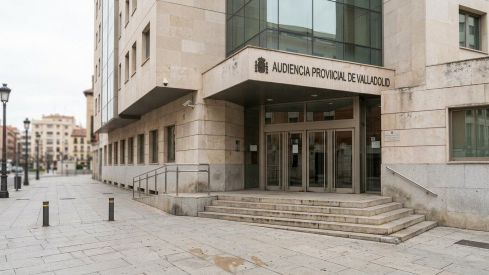
The Provincial Court of Valladolid has acquitted a Civil Guard agent accused of consulting the INTPOL file about his tenant and about the latter's uncle, who appeared as guarantor in the rental contract of an apartment located on Jacinto Benavente street in Valladolid. The ruling considers the accesses to the database proven, but does not consider it proven that they were made without authorization nor that they caused harm.
The Public Prosecutor's Office requested for the agent, stationed in Medina de Rioseco, three and a half years of prison, a fine of 7,200 euros and nine years of professional disqualification for an alleged continuous crime of discovery and revelation of secrets. The court, however, has issued an acquittal ruling in the Second Criminal Section of the Provincial Court.
The trial was marked by the absence of the complainant
The tenant who reported the facts did not appear at the oral hearing as he was of unknown whereabouts and is located in the United States. That non-appearance conditioned the development of the trial. The prosecutor recalled that he had requested the suspension of the hearing, a request that was rejected by the court, and maintained that that absence generated evidentiary difficulties.
Faced with this, the tenant's uncle and rent guarantor, Ricardo Amador, did declare, backing the accused's version. He assured that both he and his nephew had authorized the civil guard to review their data before closing the operation.
"I am a plumber, I have Civil Guard clients and I don't make any problem for them to make the inquiries they want because I have nothing to hide" - Ricardo Amador, guarantor
The defense maintained that there was consent for the consultations
Agent M.V.M. maintained that the checks were carried out with express permission from both. He set up a meeting with the tenant and his uncle several days before July 19, 2021, the date on which the contract was signed, and stated that a deposit contract was then signed in which he recorded his status as a public servant.
"Both Rubén and his uncle Andrés told me back then that since I was a civil guard I could make the necessary checks to certify that they were trustworthy people and that the payments were guaranteed" - M.V.M., accused civil guard
According to his account, he consulted the tenant's data on five occasions. In the case of the uncle and guarantor, the searches approached a dozen. The accused also maintained that a part of those consultations occurred before formalizing the rental and that another was made two years after the contract for the property he owned had expired.
One of the searches on the tenant was carried out after the contract ended and, according to the version of the civil guard, it was at the request of the tenant himself, who wanted to know if there was any complaint against him after being involved in a traffic accident. The agent assured that in that access he detected a complaint for the theft of mobile phones in Mediamarkt.
The Prosecutor's Office maintained that there was an illegal use of reserved data
The public prosecutor maintained during the trial that the accesses were not justified and that they constituted an illegal use of a database with reserved, sensitive, and constitutionally protected information. He also noted that neither of the two people consulted was being investigated for the commission of a crime.
A good part of the accusation focused on the searches made upon termination of the contract, when, always according to the Prosecutor's Office's thesis, the problems to collect the rents began. The prosecutor added that the tenant reported the agent in 2023 and requested a restraining order by stating that he was receiving pressure to pay.
"The tenant reported the agent in 2023 and requested a restraining order because he began to receive pressure to pay in which the accused told him he knew about the theft at Mediamarkt and threatened to put him in prison by telling him he had friends in the judiciary" - prosecutor
Despite that request for conviction, the Court has concluded that it has not been proven that the civil guard accessed the file without authorization from those affected nor that those consultations generated a criminally relevant harm. With that reasoning, the court has agreed to the acquittal of the agent.