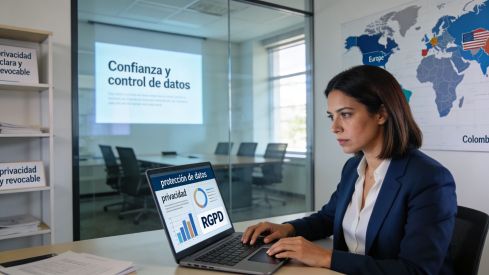
62% of users show concern about the possibility that their personal data may be used for purposes other than those authorized, according to data from Certena. This fear extends to neighborhoods and municipalities in Catalonia, where the digitalization of public and private services has increased sensitivity about privacy and the protection of personal information.
Growing concern over the use of personal data
The debate over the management of personal data intensifies in a context where automation and artificial intelligence advance in multiple sectors. 43% of users fear they will not be able to easily revoke access to their data, according to a study by Datacrédito Experian cited by Certena. This concern is perceived in urban environments as well as in smaller areas of the province of Barcelona and Girona, where the digitalization of municipal and health procedures has been especially rapid.
Demand for control and transparency in companies
Social demand is oriented towards greater transparency and effective control over personal information. Nathalia Landeta, CEO and founder of Certena, points out the importance of this paradigm shift
"In 2026 the conversation is no longer about whether companies comply or not, but whether they are capable of demonstrating real control over data and offering the user a clear, simple, and revocable privacy experience" - Nathalia Landeta, Certena
Organizations are adapting their systems to limit data capture to what is strictly necessary and strengthen access traceability. The goal is for users to be able to know at all times who is using their information, for what purpose, and for how long.
International Regulatory Advances and Local Challenges
The regulatory framework evolves at different speeds depending on the region. In Europe, greater coherence is sought between data regulation and artificial intelligence regulation. Colombia is processing a bill to modernize Law 1581 of 2012 and align it with international standards such as the GDPR, incorporating automation and artificial intelligence scenarios. For its part, the United States maintains fragmented development, led by the states.
The use of biometric data in sectors such as banking, health, or public administration poses additional challenges. Luis Miguel Bevilacqua, CTO of Certena, warns about the associated risks
"As it is unique and permanent information, its disclosure may generate irreversible impacts for the data subjects" - Luis Miguel Bevilacqua, Certena
The responsible management of personal data is consolidated as a priority on the public and business agenda, especially in cities like Barcelona, Girona, and Tarragona, where digitalization is advancing at a great pace and citizens demand clear guarantees regarding the protection of their information.