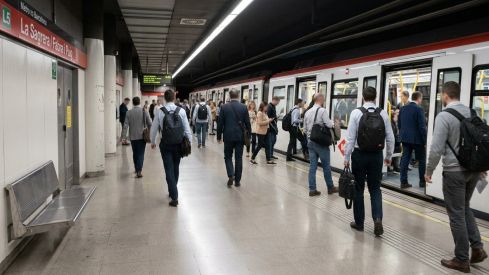
The first day of the reinforcement of Barcelona metro lines L1 and L5 left fewer crowds on platforms and less crowded trains in the morning slot, under full pressure due to the increase in travelers derived from the Rodalies crisis.
From this Tuesday, one more train runs during peak hours first thing in the morning on both lines, a measure that applies between 7:00 and 9:30 hours. The adjustment comes after several days of overload in key stations, especially at connection points with alternative road services.
Less pressure in stations like La Sagrera and Fabra i Puig
Part of the travelers who have temporarily left the train are arriving in Barcelona on intercity buses and continue the journey by metro from stations such as La Sagrera or Fabra i Puig. In this last one, the influx was reaching a limit situation, according to users who were warning even of the risk of falling onto the tracks due to the accumulation of people.
In L1, the fare increase is 10 %, a growth that has strained one of the lines with the most demand in the entire network. Together with L5, both transport more than half of the annual passenger traffic of the Barcelona metro.
"I have noticed a slight improvement, there were fewer people and the subway was not so full. I think it goes faster" - Esther, subway user
"It goes faster. There isn't much crowding" - metro user
More frequency on the two lines with more demand
With the reinforcement, L1 has a passing interval of three minutes and 35 trains per hour. On L5, the frequency is two minutes and 24 seconds, with 38 trains per hour. The objective is to absorb part of the additional flow of users who have moved to the metro due to incidents on the railway network.
The president of TMB, Laia Bonet, had announced this reinforcement in the bàsics program. The measure focuses on the first rush hour of the morning, when the largest volume of passengers was concentrating on the platforms.
The L1 gains weight due to the transfers of the alternative service
Carles García, vice president of the Associació per a la Promoció del Transport Públic, recalls that the L1 is a very important pole of demand and that it is now also receiving users of the alternative service of the R3 and R4.
"Any increase in supply is very positive" - Carles García, vice-president of the PTP
The evolution of the coming days will mark if this increase in frequency is sufficient to stably reduce saturation in especially sensitive stations in the north of Barcelona, where the impact of the Rodalies crisis has fully transferred to the metro network.