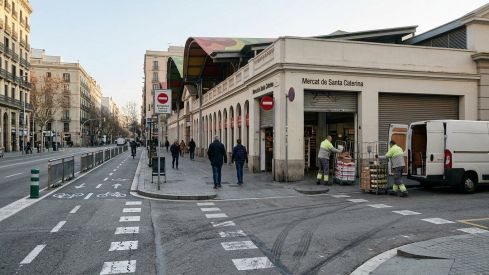
The stallholders of the Mercat de Santa Caterina have asked the Ajuntament de Barcelona to lower the traffic restrictions on the vía Laietana given the impact that, they assure, it is having on the commercial activity of the premises. The claim comes a few days before private vehicles begin to be fined on April 27 that are not from residents of the area or services.
The market, located next to one of the key connections between Ciutat Vella and the Urquinaona area, maintains that the traffic limitation complicates both customer access and daily operations. David Barroso, president of the stallholders, assures that the sector continues to drag the consequences of the long remodeling of the axis.
"During the four years the works lasted, we lost 30% of our turnover and we still haven't recovered" - David Barroso, president of the stallholders
Proposal to facilitate client access
The merchants propose that cars can circulate in an upward direction along vía Laietana if they have previously used the market's parking lot. They consider that this measure would allow to favor the arrival of buyers without completely altering the current mobility scheme.
"Via Laietana is the only artery that we have to enter or exit the market" - David Barroso, president of the stallholders
Barroso also defends a broader review of the road design. His position is to return to the model prior to the works, with two downhill lanes and two uphill lanes, understanding that it would be the most effective formula to recover fluidity in the area.
"The best solution would be to recover the mobility from before the works, that is, two downhill lanes and two uphill lanes" - David Barroso, president of the stallholders
Within that proposal, the merchants suggest modifying also the configuration of the bike lane in an ascending direction so that it shares space with the bus, in the same way that happens in a descending direction. In their opinion, that adjustment would allow gaining width to enable the two uphill lanes that they demand.
"Make the uphill bike lane like the downhill one, sharing space with the bus. Thus this lane could be expanded to the two uphill lanes we want" - David Barroso, president of the stallholders
Criticism of loading and unloading schedules
The stallholders also focus on the management of loading and unloading in front of the market. Barroso maintains that the equipment suppliers arrive before 8:00 AM, so those time slots are not decisive for the internal activity of the venue.
"The market suppliers do not use them, they come before eight in the morning. We are not saying to remove them, because there are businesses to supply, but a control or a change of schedule should be made" - David Barroso, president of the market
The complaint focuses on the fact that the current system, according to the merchants, is not yielding results. They understand that the current schedules do not adjust to the real functioning of the area and ask for some type of control or a reorganization that makes compatible the supply of businesses with better mobility around the market.
"I don't know how it will be solved but what is clear is that with these schedules it doesn't work because they are not met" - David Barroso, president of the market
With the date of April 27 already set for the start of the sanctions, the stallholders demand a municipal response that allows to alleviate access to Santa Caterina and stop the deterioration of sales that, they emphasize, have not yet recovered the level prior to the works.