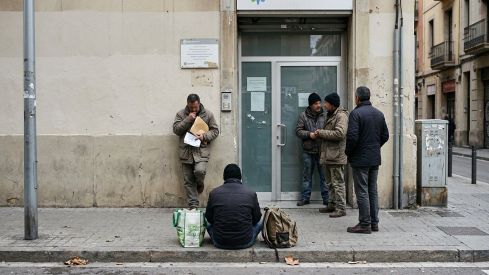
La Fundació Arrels calculates that 24% of the non-EU homeless people surveyed could avail themselves of the regularization of immigrants, although it warns that a good part of this group will face significant obstacles to complete the process.
The entity sets at 75% the percentage of people who will have serious difficulties due to their situation of social exclusion. The main problem, it points out, is not only administrative. Also economic. The costs derived from translations, legalizations and the obtaining of documents from the country of origin move between 600 and 700 euros.
The cost and the lack of documentation complicate the process
Eva Hobeich, head of the entity's legal team, maintains that the cost is "one of the biggest problems" that people who try to avail themselves of this regularization route will encounter.
"It is one of the biggest problems" - Eva Hobeich, head of the entity's legal team
To that economic barrier is added the difficulty of proving residence in Spain. The procedure requires a historical registration, a particularly complex process for those who live on the street and have not been able to maintain a stable administrative link with an address.
The situation is framed within a context of strong residential vulnerability. 54% of homeless people surveyed last year rated as "difficult or very difficult" to keep their housing, a figure that reflects the fragility with which many arrive at any regularization process.
Arrels sees margin to regularize, but demands accompaniment
Hobeich points out that, despite the obstacles, there is room for a part of this group to access the procedure. The jurist defends that it opens "the opportunity to give civil rights to a person who has not had them for a long time and it will not be let pass".
"The opportunity to give civil rights to a person who has not had them for a long time and it will not be missed" - Eva Hobeich, head of the entity's legal team
The legal person in charge also warns that the process will not be simple for people in a street situation if they do not have specialized support. In her judgment, it is not feasible to face it without the accompaniment of a social entity and considers the intervention of a jurist necessary to be able to gather the documentation and overcome the required requirements.
"It is not feasible that the process can be done without the accompaniment of a social entity" - Eva Hobeich, head of the entity's legal team
Arrels' forecast thus paints a double reality. On the one hand, a part of the non-EU homeless people could benefit from the regularization. On the other hand, the lack of resources, the difficulties to prove residency and social exclusion threaten to leave out many of the potential beneficiaries if a sustained accompaniment is not articulated.