Europe warmed in 2025 at a much faster rate than the planet as a whole, with clear signs in the Arctic, the Mediterranean, rivers, and snow cover. The new annual report on the state of the climate in Europe, published this Wednesday by the European Centre for Medium-Range Weather Forecasts, which manages the Copernicus climate change service, together with the World Meteorological Organization, places the continent as the fastest warming.
The document puts the warming rate in Europe over the last 30 years at 0.56 ºC per decade. The global average is 0.27 ºC per decade, and in the Arctic it rises to 0.75 ºC per decade. The study concludes that the coldest regions of the continent and the Arctic area are undergoing a sustained warming trend.
"Europe is the continent that is warming most rapidly and the effects are already serious." - Florian Pappenberger, Director General of the European Centre for Medium-Range Weather Forecasts
Temperatures above average across almost the entire continent
The report indicates that at least 95% of Europe registered annual temperatures above the average in 2025. Heatwaves reached a large part of the continent, from the Mediterranean basin to the Arctic. Norway, Sweden, and Finland experienced what the study describes as the worst heatwave in their history.
Inside the Arctic Circle, 21 days with records above 30 ºC were chained during 2025. At the same time, 90% of Europe had fewer days of cold stress than usual and minimum temperatures remained above average for much of the year.
Less snow and glacier mass loss
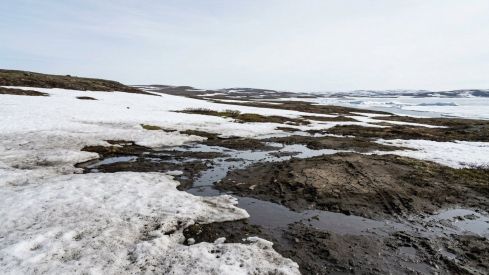
At the end of winter, in March 2025, the snow-covered area in Europe was 1.32 million square kilometers, 31% below the average. This is the third-lowest extent since records began in 1983.
The report also confirms a net loss of glacial mass. Iceland registered the second largest ice loss in its history. Greenland lost 139 gigatons of ice, about 139 billion tons, an amount equivalent to approximately 1.5 times the volume of ice stored by the glaciers of the Alps.
Records at sea and growing pressure on the Mediterranean
The oceans absorbed around 90% of the excess heat generated by greenhouse gas emissions. In that context, 2025 was the fourth year of record heat in the sea and the European oceanic region reached the highest observed annual sea surface temperature to date.
Marine heatwaves affected 86% of the European ocean region and 36% of those episodes were classified as severe or extreme. Severe marine heatwave conditions were detected in the Norwegian Sea.
In the Mediterranean, the average annual sea surface temperature was the second highest ever recorded. The report adds that this sea has registered at least one day of strong marine heatwave conditions in each of the last three years.
Drought, fires, and rivers with less flow
The study also outlines a dry scenario in a large part of the continent. In 2025, river flows were below average for 11 months and 70% of river courses registered levels lower than usual. It was also one of the driest years for soil moisture since 1992.
In the south and east of Spain, heat and drought translated into unprecedented forest fire activity. Across Europe, 1,034,000 hectares burned, an area larger than Cyprus. More than half of the emissions from these fires were located in Spain.
The report also includes the impact of storms and floods that affected thousands of people in different parts of Europe, although it specifies that extreme rains and floods were less widespread than in previous years.
European restoration objectives
Faced with this scenario, the European Union maintains legally binding objectives to restore ecosystems on a large scale. The commitment involves acting on at least 20% of land and marine areas before 2030 and extending this restoration by 2050 to all ecosystems that need it.
The balance of 2025 leaves a climate map with persistent heat, less snow, more pressure on seas and glaciers, and a prolonged drought in large areas of the continent. The report places these changes as an already consolidated trend in Europe.