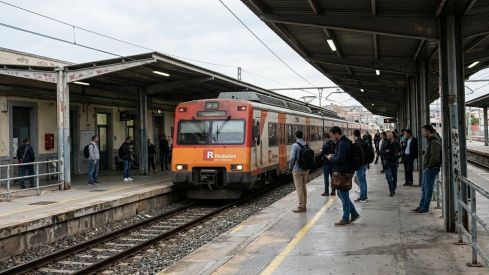
Journeys on Rodalies and regional trains between Barcelona and the 24 regional capitals of the network are now longer than in May 2000. The comparison, elaborated from the official timetables in force then and those that were in force just before the Gelida accident, reflects a generalized increase in travel times in a good part of Catalonia.
The analysis takes as reference the fastest routes in the direction of Barcelona and is based on officially disseminated schedules, which do not always coincide with real times. Even so, the trend is clear. 25 years ago many trains took up to half an hour less and, furthermore, they made fewer stops.
The R4 concentrates the biggest increases
The R4 line is the one that accumulates the most marked differences compared to a quarter of a century ago, especially in the section that crosses the Penedès and the Baix Llobregat. In several of its main corridors, the increase in travel time is notable.
Between Martorell and Barcelona Sants, the shortest journey was 28 minutes in the year 2000. Before the Gelida accident, it had increased to 39 minutes, with two more stops. Between Vilafranca del Penedès and Barcelona Sants, the minimum time has risen from 53 to 70 minutes. In the case of El Vendrell, the journey has increased from 69 to 90 minutes.
More time also on the R3 and on the Ponent lines
The R3 also shows a worsening in times. The fastest trains between Vic and Barcelona made the journey in 71 minutes in the year 2000, with a stop at eight stations. In 2024, the minimum was 86 minutes and with 11 stops. From Puigcerdà and Ripoll towards Barcelona, the journeys were about 20 minutes shorter 25 years ago.
Lines R13 and R14, which connect Barcelona with the regions of Ponent, also register increases. In the year 2000, the fastest regional trains between Lleida and Barcelona Sants covered the journey in 2 hours and 8 minutes with a stop at 11 stations. Last November, that same route added six more stops and was 20 minutes slower.
Other capitals of these lines, such as Les Borges Blanques, Valls and Montblanc, present increases of between 15% and 25% in travel time.
Tarragona, Reus and Girona also worsen their records
In the lines of Camp de Tarragona and Terres de l"Ebre, the journeys are now about 15 minutes slower than a quarter of a century ago. Between Tarragona and Barcelona, the travel time is six minutes longer than at the end of the last century. On the R14, between Reus and Barcelona, the journey is 10 minutes slower than 25 years ago.
Girona also loses speed in the railway connection with Barcelona Sants. The regional journey now needs seven more minutes and an additional stop compared to the last year of the last century.
More stops and a network without more capacity
Adrià Ramírez, president of the Associació per a la Promoció del Transport Públic, points to a change in the operation of the network.
"There is an increase in trains that stop at all stations and in frequencies, but what has not increased is the capacity of the network" - Adrià Ramírez, president of the PTP
Joan Carles Salmerón, director of the Centre for Transport Studies, links these data to a prolonged deficit of investments in the infrastructure, a situation that in his opinion has ended up causing a weakness of the railway system.
"Three or four years ago, when money finally started to be invested, works have begun that have also further increased travel time" - Joan Carles Salmerón, director of the Centre d"Estudis del Transport
Salmerón demands the recovery of semi-direct trains as one of the formulas to cut times in a network that, despite the increase in services and frequencies, today presents longer journeys than those of 25 years ago between Barcelona and a good part of the regional capitals connected by rail.