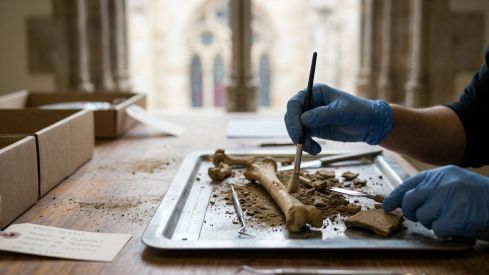
The Pedralbes Monastery has opened and studied eight 14th-century tombs, including that of Queen Elisenda de Montcada, in an archaeological investigation that coincides with the 700th anniversary of the monastery's founding. The work has made it possible to document for the first time a set of medieval tombs that had remained intact until now.
The main uniqueness of the project is that the opening of the tombs did not confirm a single funerary narrative, but rather uncovered burials much more complex than expected. In contrast to individualized sepulchers like the queen's, the team has located remains of up to 25 individuals in the eight tombs, with family pantheons that preserved the bones of children and young women, as well as some mummified remains and hair.
The exhumations began in the autumn of 2024 within the monastery itself
The work began in the autumn of 2024 and was carried out in a provisional laboratory set up on the premises. The organization responded to a request from the community of Poor Clare nuns, who demanded that the remains not leave the monastery.
There were only occasional transfers for medical tests. In the case of Elisenda de Montcada, some remains were taken to the Hospital del Mar for X-rays and CT scans.
The intervention has included the tombs of the queen herself, those of the first two abbesses, Sobirana d'Olzet and Francesca Saportella, and those of three nuns, Constança de Cardona, Elionor de Pinós, and Beatriu de Fenollet, in addition to two secular nobles, Artau de Foces and Ròmia de Sarrià.
"If we wanted to learn more about that time, we thought that the remains of the people who founded it could give us information" - Anna Castellano-Tresserra, director of the Pedralbes Monastery Museum
Carme Aixalà, head of the monastery's collections, explained that for several of these people, only their surnames and date of death were known. The opening of the burials has expanded that knowledge with physical, funerary, and biographical data that were not recorded in the preserved documentation.
The queen's sepulcher preserved a medieval box and a fabric similar to cotton
In the tomb of Elisenda de Montcada, a medieval wooden box appeared with the remains inside, wrapped in a cotton-like fabric. The anthropological study concludes that the queen died around 70 years of age, that she was over 1.60 meters tall, and that she suffered from a metabolic disease associated with excessive eating.
The analyses have also detected textile evidence indicating that she was buried in a nun's habit, even though she never took vows. This finding adds a new element to the interpretation of her burial and her connection with the community of Pedralbes.
"It was an opportunity to study the physical characteristics of these people and also everything surrounding funerary gestures and burial systems in these types of communities" - Josep Maria Vila, co-director of the project
The research has also found a relevant exception in the tomb of Francesca Saportella. The sepulcher of the second abbess was opened in modern times and today contains materials from different eras and the remains of at least nine people, with no trace of the religious woman.
The project involves the participation of the University of Barcelona, the Rovira i Virgili University, and the Natural Sciences Museum of Barcelona, among other scientific institutions. Part of the work now involves DNA analysis of six individuals buried individually, with the aim of confirming kinship and, in the case of Elisenda de Montcada, determining eye and hair color for facial reconstruction.
betevé has produced the documentary 'Pedralbes awakening the queen' about this research, while the complete results of the studies and analyses will be published in 2027.