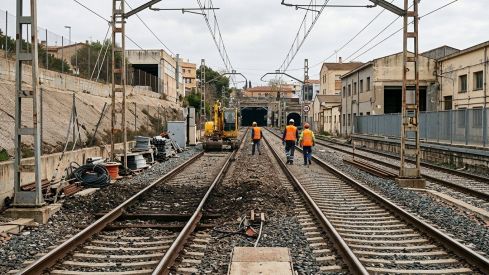
The emergency works in Rodalies have allowed to eliminate 78 speed limitations since March, although the network continues to accumulate 179 restrictions at different points of the Catalan railway infrastructure. The volume of incidents on circulation continues to have a direct impact on the service, especially on line R4, where the Government admits a systematic delay of between 10 and 15 minutes.
The situation comes months after the Gelida accident, from which the state of the network was reviewed and urgent actions were accelerated. Since then, 41 speed limitations due to unforeseen elements have also been incorporated, which keeps the total number of restrictions high despite the work carried out.
More restrictions than before the Gelida accident
Before the incident there were 95 speed limits on the network. Currently, after the revisions and measures adopted, there are 84 more. That increase responds to the diagnosis made after the accident, when 31 sections for immediate action and 130 slopes that require mitigation measures with temporary speed limits were detected.
The objective of these restrictions is to maintain circulation with safety conditions while the stabilization, repair, and reinforcement works advance at different points of the infrastructure. The consequence, however, continues to be a loss of regularity in several Rodalies services.
The R4 drags constant delays
Renfe is programming 94% of the services prior to the accident, which is equivalent to 846 daily services. Even so, the effect of speed limitations is still visible in daily operations, especially on the R4, where that usual delay of between 10 and 15 minutes is acknowledged.
To contain cascading incidents and avoid further service degradation, reinforcement trains and drivers have been positioned at the termini. The measure seeks to absorb part of the alterations and reduce the risk that a specific delay ends up affecting more trains throughout the day.
Works in Rubí and tree felling on the network
One of the most delicate points is located in the Rubí tunnels, where work is being done on a critical 60-meter section. This intervention forces the cutting of freight traffic for seven weeks, within the package of open actions to correct problems detected in the infrastructure.
In parallel, since January, 13,600 trees have been felled on the railway network. These tasks are part of the preventive and emergency works activated to reduce risks on tracks, slopes, and areas close to the route.
107 million for emergency actions
The budget mobilized for this set of interventions amounts to 107 million euros. The financing comes from emergency contracts linked to storm Harry, which allowed activating urgent works in different points of the network.
The operational forecast maintains almost all recovered services, but the service remains conditioned by a number of restrictions much higher than before the Gelida accident. While the works advance and the most sensitive points are corrected, Rodalies continues to operate with tight margins and with impacts that are still noticeable in the daily lives of thousands of travelers.