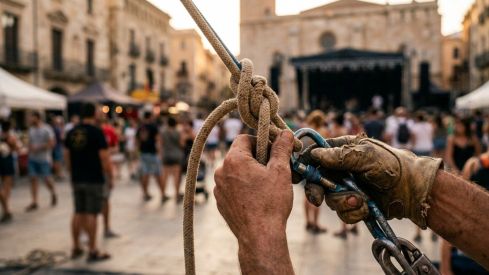
El Trapezi closed its thirtieth edition in Reus with 45,000 attendees between Wednesday and Sunday and an occupancy rate close to 100% in the indoor shows. The festival also brought together more than 300 accredited professionals and 85 journalists, with activities spread across street stages, indoor venues, and market spaces such as Cal Massó and La Palma.
The assessment comes with an idea that has marked this edition. The festival maintains a strong capacity to attract audiences, but the municipal team and the artistic direction insist that the challenge is not to continue growing in volume, but to sustain the format without the attendance ultimately conditioning the experience of the public and the sector.
Recasens advocated for consolidating the festival without increasing public pressure
Daniel Recasens, Councilor for Culture of the Reus City Council, identified this balance as one of the priorities of the event. In his assessment, the city could absorb more visitors, although the objective is to maintain the conditions for access and attendance of the programming.
"We are not looking to grow only in numbers. We want quality. The city could host more people, but the objective is to guarantee a complete and satisfactory experience. It's not about dying of success, but about consolidating it sustainably" - Daniel Recasens, Councilor for Culture of the Reus City Council
The mayor, Sandra Guaita, stated that the festival reaches its thirtieth anniversary in a period of stability. Guaita affirmed that El Trapezi is in "good health after 30 years" and that it continues to generate "excitement, joy, a desire to participate, and spaces for critical thinking."
Alongside public attendance, the festival maintained its professional dimension. This edition was attended by more than 300 accredited professionals from the sector to participate in showcases and meetings at Cal Massó and La Palma, two of the central points of the market.
The directors will once again opt for the contract after four years in charge
Cristina Cazorla and Alba Sarraute, co-artistic directors of El Trapezi, announced that they will once again apply for the new contract tender. Both have been in charge of the event for four years and defended the model of professional relationship that has been taking shape during this period.
Cazorla explained that the market has changed its internal functioning and that immediate sales are now less prioritized. In her opinion, many programmers leave Reus with projects, co-productions, and ideas for medium-term support.
"We have gone from a space of tension to a space of support and collaboration. The artist feels more secure and the programmer accompanies" - Cristina Cazorla, co-director of Trapezi
She also stressed the external projection of the event and assured that what happens at Trapezi ends up circulating outside of Reus. The edition has featured artists from different parts of Europe, as well as Brazil and Canada.
Alba Sarraute focused on the effect of taking certain proposals into public spaces. The co-director emphasized that some productions conceived for indoor spaces generate a coexistence of different ages, cultures, and identities in the street around the same performance.
Media coverage accompanied this professional and artistic reach, with 85 journalists accredited to follow the event. The setup was completed with the presence of more than 300 industry professionals at the market meetings held at Cal Massó and La Palma.