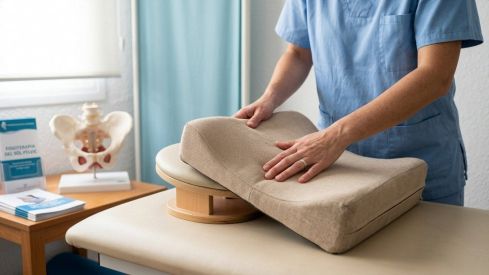
The Col·legi de Fisioterapeutes de Catalunya has launched the talk tour 'Anal health and pelvic floor, let's break taboos' to raise awareness of dysfunctions that many patients do not consult about. Last week, one of the sessions was held at the Faculty of Medicine and Health Sciences of the URV in Reus, with a conference by physiotherapist Marta Jiménez.
The paradox, as the specialist explained, is that these are frequent problems with treatment options, but they remain hidden both inside and outside the consultation room. The question about anal incontinence, in fact, is not usually part of the routine medical history in primary care centers.
Jiménez, specialized in urogynaecology and pelviperineal re-education, maintains that this silence delays treatment and perpetuates conditions that could be addressed earlier. The tour aims precisely to break this barrier and dismantle widespread beliefs about hemorrhoids, menopause, or leakage.
"It locks you up at home. Nobody says they have to wear a diaper or that they have hemorrhoids" - Marta Jiménez, physiotherapist
Physiotherapy treats incontinence, fissures, and constipation that are often not referred
In her presentation in Reus, the specialist pointed out that many people do not consult due to lack of knowledge, and sometimes, healthcare professionals themselves do not know where to refer these cases. She identifies this as one of the main barriers for patients to receive treatment.
In addition to anal incontinence, specialized physiotherapy can treat chronic constipation, fissures, and hemorrhoids. Jiménez argued that more widespread attention in this area would also help reduce waiting lists in the healthcare system.
"It is only treated with laxatives. So, it is strange that a person knows that a common problem, such as incontinence, constipation, or an anal fissure, can be treated with physiotherapy. And the results are really very powerful and very effective" - Marta Jiménez, physiotherapist
The approach she described combines lifestyle changes and specialized treatment. It includes dietary changes, breathing techniques, and the use of a stool to facilitate a physiological position for defecation and avoid straining, a measure aimed at preventing hemorrhoids.
In the clinic he directs, they also use radiofrequency, photomodulation, and electromagnetic fields to reduce pain or improve scarring. These are resources that, as he explained, are added to manual work and functional re-education.
The talk at URV of Reus gave examples of patients who took months to ask for help
During the conference, Jiménez recounted cases that illustrate the weight of taboo in daily life. He explained that they treated a man who was unable to communicate to his closest family members that he suffered from anal incontinence.
He also mentioned the case of a woman who, after her first childbirth, had been suffering from anal incontinence for eight months and thought it was normal. That type of normalization, he maintained, delays consultation and prolongs symptoms that can be treated.
The tour promoted by the Col·legi de Fisioterapeutes de Catalunya aims to debunk ideas such as hemorrhoids only being associated with age or that losing things with menopause is part of normality. Marta Jiménez summarized that objective with a concrete idea in the Reus talk when she advocated for "providing tools, resources, and doing prevention".